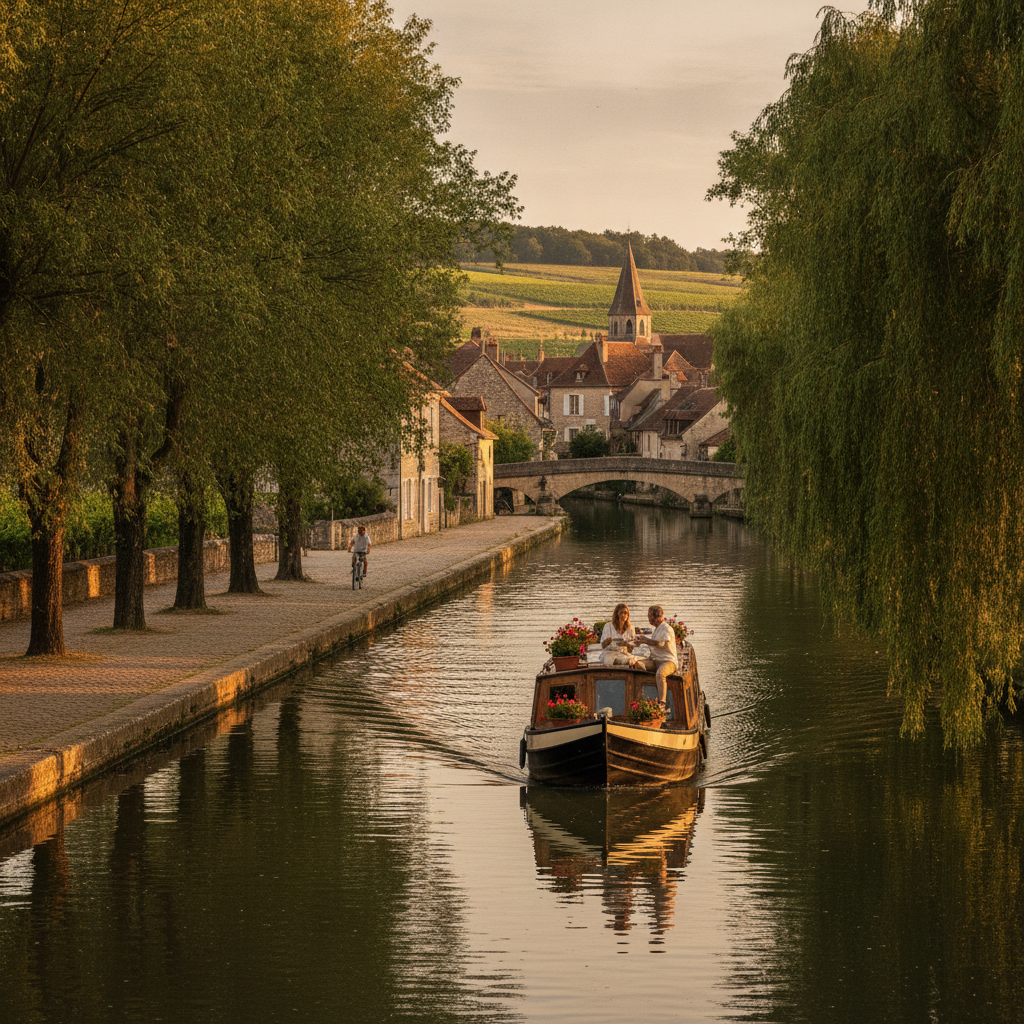
There are places in the world where time does not simply pass — it pools. Northern Burgundy is one of them. The canal towns strung along the Canal de Bourgogne and the Canal du Nivernais have been organizing their days around water for centuries, and a week spent moving through them leaves a particular impression: that the rhythm of a place is not incidental to its character but is, in fact, its deepest expression. The boats move slowly because the locks require it. The markets open and close on schedules that predate modern commerce. Even the light seems to follow a more patient logic here, arriving softly over the water and departing without urgency.
The Architecture of a Slow Passage
The town of Tonnerre, set along the Armançon River before it feeds into the canal system, offers a useful entry point into this world. Its medieval streets have a quality of uninterrupted continuity — a boulangerie opens at the same hour it has for decades, the church bells mark time with bureaucratic precision, and the guinguette culture along the waterfront, a tradition of outdoor social gathering rooted in French riverside life, reasserts itself each afternoon without fanfare. The guinguette (a casual open-air café or dance venue historically associated with riverbanks) is not a nostalgic performance for visitors; it is simply how people here have chosen to spend their evenings, a habit sustained by the geography of the water. To arrive expecting spectacle is to misread the invitation entirely.
The locks themselves — the écluses — are perhaps the most honest teachers in this landscape. Each one requires the boats passing through to stop, wait, and proceed on the lock-keeper's terms rather than their own. The écluse (a canal lock that controls water levels between sections) operates on a principle of enforced patience: the gates open when the water is ready, not when the traveler is. For those accustomed to measuring progress in miles covered and itineraries completed, the first few locks can feel like an imposition. By the fourth or fifth, something shifts. The waiting becomes less like delay and more like punctuation — a pause that gives the journey shape.
What the Water Teaches About Local Time
Châtillon-sur-Seine, slightly north of the main canal corridor, sits at a kind of cultural crossroads between the waterway world and the agricultural rhythms of the Côte-d'Or. Its Wednesday market draws farmers from surrounding villages who still sell according to seasonal availability rather than consumer demand — a distinction that feels quietly radical in the context of modern retail. The vendors here are not performing rusticity. They are simply operating within a framework that the waterway towns have preserved almost by accident: the idea that supply should shape expectation, not the other way around. A traveler who arrives hoping for strawberries in October will leave empty-handed, and that, too, is part of the lesson.
The broader region around Auxerre, the largest city along the Canal de Bourgogne's northern stretch, illustrates how waterway culture can anchor an urban identity without dominating it. Auxerre's old town rises steeply from the Yonne River, and the relationship between the city's elevated cathedral district and its low-lying quays is almost theatrical — the sacred up high, the commercial and communal down at the water. In the early mornings, joggers and dog walkers share the quay paths with boaters readying their vessels, and the informal democracy of this shared space feels characteristic of canal-town life more broadly: no single activity claims dominance, and the pace adjusts to accommodate everyone moving through it.
The Culture of Slow Commerce and Staying Power
Smaller villages like Tanlay, known for its Renaissance château and its position near a quiet canal junction, demonstrate what happens to commerce when tourism has not yet reordered local priorities. The single café in the village square serves coffee at a pace that suggests the barista does not regard speed as a virtue. A small épicerie stocks what the village needs — not what a visitor might hope to photograph. The term *commerce de proximité* (literally, nearby commerce — the French concept of essential local retail within walking distance) carries real meaning in these towns, where the absence of chain retail has preserved a kind of economic intimacy that larger cities have largely abandoned. To shop in Tanlay is to participate in a system built on familiarity rather than efficiency.
This is where waterway culture reveals its most durable lesson. The canal system of northern Burgundy was built in the eighteenth and nineteenth centuries to move goods — wine, grain, timber — across a difficult interior landscape. The towns that grew alongside it were organized around the needs of that movement: storage, provisioning, rest, repair. When barge traffic declined in the twentieth century and leisure boating gradually took its place, the infrastructure remained but the urgency evaporated. What was left was a set of towns still shaped by the logic of slow movement, still calibrated to the needs of people arriving by water rather than road. The unhurried quality that travelers now find so appealing was not designed as an amenity. It was simply never designed away.
Finding Your Own Pace Along the Water
For those who make the journey to this part of France, the adjustment takes a few days. You stop checking arrival times quite so compulsively. You start noticing which café has the best angle on the afternoon light. You develop opinions about which stretch of towpath is worth walking twice. The Canal de Bourgogne offers hire-boat options from operators based in Migennes and Tonnerre, allowing travelers to experience the écluse system firsthand rather than simply observing it from the bank — a genuinely different relationship with the landscape that no hotel stay can replicate. The Avallon area, slightly inland, rewards the traveler who combines canal time with forays into the wooded Morvan hills, using the water as a basecamp rather than an attraction.
What a week in northern Burgundy ultimately offers is not a checklist of experiences but a recalibration of expectation. The canal towns do not reward those who treat them as destinations to be efficiently consumed. They open, instead, to those willing to accept the pace they set — the pace of the water, the locks, the market morning, the long lunch. That patience is not a concession to slow infrastructure. It is, as it turns out, the entire point.