Street food is rarely just about eating. In cities where outdoor markets have operated for generations, the act of buying a bowl of noodles from a roadside vendor carries social weight that a restaurant transaction simply cannot replicate — it is a ritual of belonging, an exchange embedded in the rhythms of neighborhood life. Nowhere is this more apparent than in Chiang Mai, the northern Thai city whose night markets function less as tourist attractions and more as the living connective tissue of a community that has been feeding itself outdoors for centuries. To spend an evening wandering these markets is to watch a city breathe.
The Market as Social Architecture
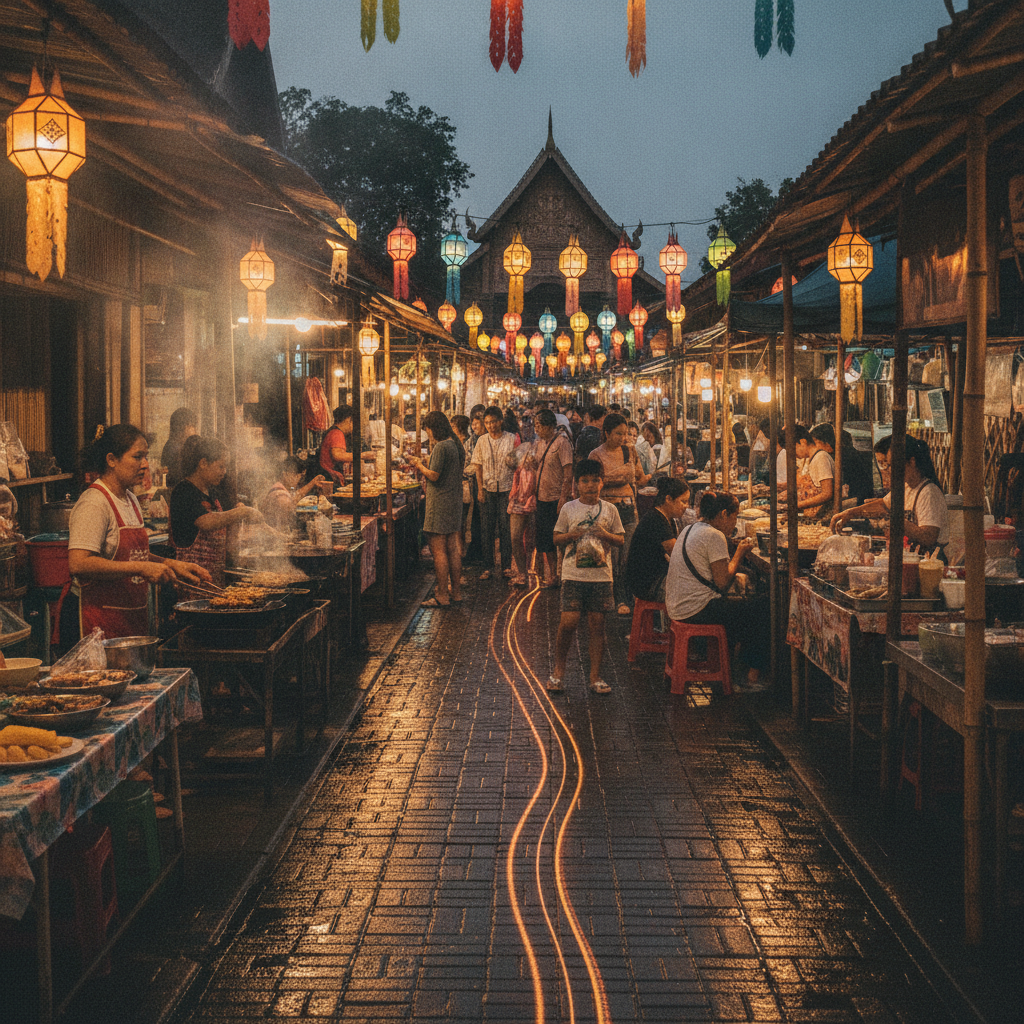
Chiang Mai's most iconic gathering point, the Sunday Walking Street along Wualai Road, transforms a quiet silversmith district into a dense corridor of vendors, musicians, and neighbors by late afternoon each week. What strikes most visitors isn't the volume of food on offer but the ease with which people occupy the space — elderly residents pulling small carts, families spreading out on low plastic stools, young vendors tending charcoal grills with practiced calm. The market here functions as what urban researchers call a "third place" — neither home nor workplace, but the shared ground where community identity is continuously rehearsed. The layout is not accidental; vendors tend to cluster by specialty and long-standing relationships, creating informal zones that regulars navigate by memory rather than signage.
The Talad Warorot market, known locally as Kad Luang or the "Great Market," operates on a different register entirely. It is not curated for visitors. Its lower floors deal in dried goods, flowers, and northern Thai textiles, while the upper levels and surrounding lanes host food vendors whose customers are almost entirely local. The *khao soi* — a rich coconut curry noodle soup regarded as the defining dish of northern Thailand — served in the surrounding alleyways tastes measurably different from the versions plated up for international audiences a few kilometers away. The difference lies not in recipe adjustments but in the absence of performance. The cook is not explaining the dish; she is simply making it, as she has done every morning for years, for people who already know what they are eating.
Food as a Language of Place
Street food culture in Chiang Mai is deeply inflected by the traditions of the Lanna Kingdom, the independent northern Thai civilization that maintained a distinct cultural identity from central Thailand for centuries. The term *Lanna* itself refers to "a million rice fields," and the agricultural abundance of the north shaped a cuisine that is earthier, more herb-forward, and less sweet than the dishes most travelers associate with Thai food internationally. Dishes like *laab khua* — a dry-roasted meat salad seasoned with dried spices rather than lime and fish sauce — or *sai ua*, the intensely fragrant northern Thai pork sausage sold in coiled lengths at almost every market stall, carry flavors that locate the eater geographically and historically. To eat *sai ua* at the Chiang Mai Night Bazaar near Chang Khlan Road is to consume something with a specific regional address.
This regional specificity is part of what makes night markets function as community anchors rather than simply food distribution points. When a dish is tied to a place, eating it in that place becomes an act of cultural affirmation. Vendors who have operated in the same spot for decades are not just selling food — they are holding a point on the map steady, maintaining a consistency that the surrounding city, increasingly shaped by digital commerce and international tourism infrastructure, cannot always guarantee. Regulars return not only for taste but for the reassurance of continuity.
What the Vendor's Routine Reveals
One of the less-discussed aspects of street food culture is the extraordinary discipline it requires. The vendors who populate Chiang Mai's markets — particularly those operating in the Nimman area near Nimmanhaemin Road, a neighborhood that has shifted considerably toward boutique cafés and co-working spaces — often arrive hours before sunset to prepare broths, portion ingredients, and arrange their setups with an efficiency that reflects years of refinement. There is no back-of-house in a stall measuring two meters wide; mise en place is spatial, and every container and utensil has a fixed position determined by the sequence in which it will be needed. Watching this setup process, for those who arrive early enough, offers a kind of transparency that formal restaurants rarely permit — the full labor of cooking is visible, unmediated.
This visibility matters socially. In communities where street food has long been the primary mode of eating outside the home, the vendor is a known figure rather than an anonymous service provider. Regulars greet vendors by name, adjust orders without explanation, and linger in ways that the transactional logic of a restaurant interior rarely encourages. The market stall, precisely because it lacks walls, creates a particular kind of openness — both literal and social.
The Traveler's Particular Position
When you step into one of Chiang Mai's night markets as a visitor, the experience can feel immediately generous — the smells, the warmth, the sense of being welcomed into something already in motion. It's worth sitting with that feeling carefully, though, rather than simply consuming it. You are a guest in a space that functions primarily for someone else's daily life, and the awareness of that distinction tends to change how you move through it. Ordering from a vendor who doesn't share your language, pointing and nodding and accepting what arrives, strips the experience down to its essentials — the food, the exchange, the moment. The markets around Pratu Chiang Mai, the ancient southern gate of the old city, are particularly good for this kind of quieter immersion, drawing fewer international visitors while maintaining a pace that rewards patience. Go without a checklist of dishes to photograph. Let the market set the terms. What you'll find, if you stay long enough, is that you've stopped being a tourist moving through a spectacle and started being, briefly and imperfectly, part of the rhythm of the place.
The night markets of Chiang Mai began, as most enduring things do, as practical solutions to practical needs — ways for a community to feed itself efficiently at the end of a working day. That they have also become spaces of social cohesion, cultural memory, and quiet identity is not incidental but inevitable. Street food, at its most authentic, has always done more than nourish the body. It holds a community's story at a temperature that keeps it from going cold.