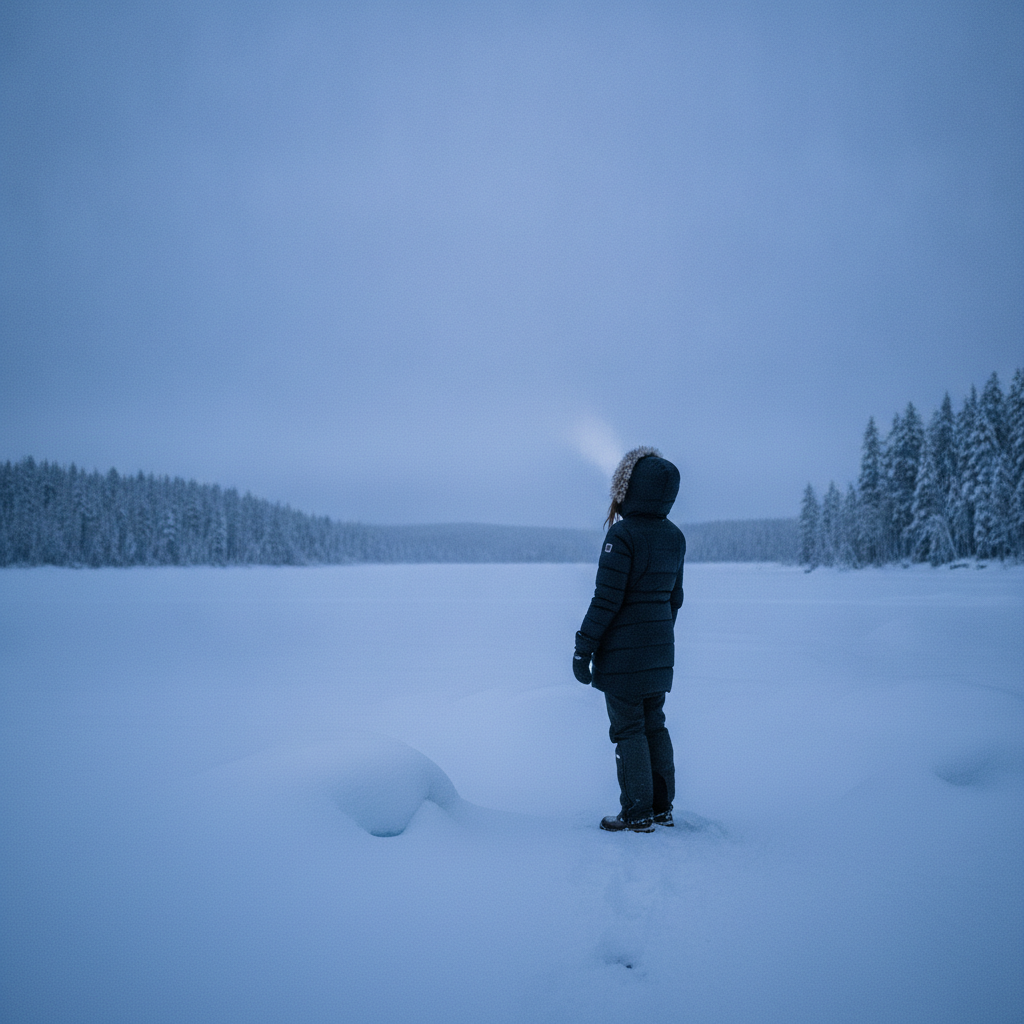
There is a particular quality to silence that most people have never encountered — not the absence of noise, but the presence of something vast and unhurried that occupies the same space where sound usually lives. Finnish Lapland in deep winter offers exactly this. When temperatures drop well below freezing and the sun barely grazes the horizon before retreating again, the region north of Rovaniemi enters a state that Finns call *kaamos* — the polar night — a period of weeks when true daylight dissolves into a long, blue-grey twilight lasting only a few hours each day. For travelers conditioned by cities and schedules, arriving into this world is not merely a change of scenery. It is a recalibration of the senses, one that happens slowly and without permission.
The landscape itself enforces a kind of quiet. Snow absorbs sound with startling efficiency, so that forests of spruce and birch along the Ounasjoki River valley become almost acoustically sealed. Footsteps vanish. Wind, when it comes, feels distant. The cold — genuinely harsh cold, the kind that tightens the face within seconds — further compresses the world inward, pushing attention toward breath and body rather than outward toward distraction. Travelers who arrive expecting a picturesque winter holiday often find something more unsettling and more useful: the sudden awareness of how rarely they have ever simply sat with themselves inside genuine quiet.
When Darkness Becomes a Different Kind of Light
The instinct, for most visitors, is to resist *kaamos* — to fill the dim hours with activities, to seek out the aurora borealis over Saariselkä or book every available reindeer safari. These experiences are genuinely beautiful and carry their own cultural weight. But those who allow themselves to settle into the rhythm of low light rather than fight it tend to report a shift that's harder to name. The Finnish concept of *hiljaisuus* — a deep, valued quietness that goes beyond mere silence — begins to feel less like deprivation and more like permission. Permission to slow thought, to let conversations breathe, to feel the day without measuring it.
Darkness in this context does not mean gloom. The sky over Inari in January holds extraordinary color — deep indigo, bruised violet, the occasional smear of green where the aurora traces its path. Moonlight on snow creates a luminosity that renders headlamps unnecessary on clear nights. The adjustment from artificial to natural light cycles, which initially leaves many travelers disoriented, eventually settles into something their bodies seem to recognize as ancient and correct. Sleep deepens. Meals feel more deliberate. The body's relationship with time, usually governed by phone screens and overhead fluorescents, begins to reorient itself around something older.
The Sámi Understanding of Presence in a Cold Land
The indigenous Sámi people have inhabited the northern regions of Finland, Norway, Sweden, and the Kola Peninsula for thousands of years, and their relationship with winter is not one of endurance but of attunement. The Sámi language contains numerous words for different types of snow and ice — distinctions that encode practical knowledge about terrain, safety, and reindeer behavior — revealing a culture built on precise attention to the immediate physical world. For outside travelers, even a surface encounter with this perspective shifts something. It reframes cold not as an obstacle to experience but as the texture of experience itself.
Visiting communities around Hetta or participating in ethical cultural programs offered through Sámi cultural centers near Enontekiö provides context that no guidebook can fully supply. The practice of moving quietly through a winter forest, reading the landscape for what it reveals rather than what it conceals, asks something of the observer that comfort-optimized travel rarely demands: patience without agenda. This is not a skill most modern travelers arrive with, and its absence becomes visible the moment the noise stops and there is nothing left to buffer the present moment.
Stillness as Something You Must Learn to Tolerate
What becomes clear, often around the third or fourth day in deep Lapland winter, is that stillness is not passive. It requires a kind of active surrender that feels counterintuitive to people whose days are structured around output and responsiveness. The cold enforces this lesson physically — moving slowly conserves warmth, rushing through a frozen landscape is both dangerous and exhausting — so the body begins to educate the mind by necessity. Breath slows. Observation sharpens. The gap between one thought and the next widens in ways that feel unfamiliar but not unwelcome.
This is, in effect, what travelers return from Lapland having discovered: not a destination exactly, but a different quality of attention. The darkness does not depress — it narrows the field of relevance until what remains feels essential. A cup of *glögi*, the spiced Nordic mulled wine warming both hands at a cabin table, carries a weight of pleasure that the same drink could never carry in a brightly lit café. Cold makes warmth meaningful. Silence makes conversation precise. These are not philosophical abstractions in Lapland; they are the direct sensory outcomes of where you are.
What You Carry Back From the Quiet
For those who travel to Finnish Lapland willing to let the environment work on them rather than simply moving through it, the experience tends to surface in unexpected ways once they've returned home. The specific memory of standing in a birch forest near Pallas-Yllästunturi National Park at three in the afternoon, watching darkness deepen while the trees stood absolutely still against a pale sky — that image doesn't fade the way ordinary travel memories do. It stays functional. It can be returned to. In the months that follow, when noise and speed reassert themselves, that remembered quality of *hiljaisuus* remains available as a reference point, a felt knowledge of what it is to be genuinely quiet and genuinely present at the same time.
There is a kind of silence, most people have never encountered it, that reveals the traveler to themselves more than it reveals any landscape. Finnish Lapland offers exactly this — and what begins as disorientation in the deep cold and failing light eventually resolves into something travelers find themselves quietly grateful for, long after the warmth of ordinary life has returned.
