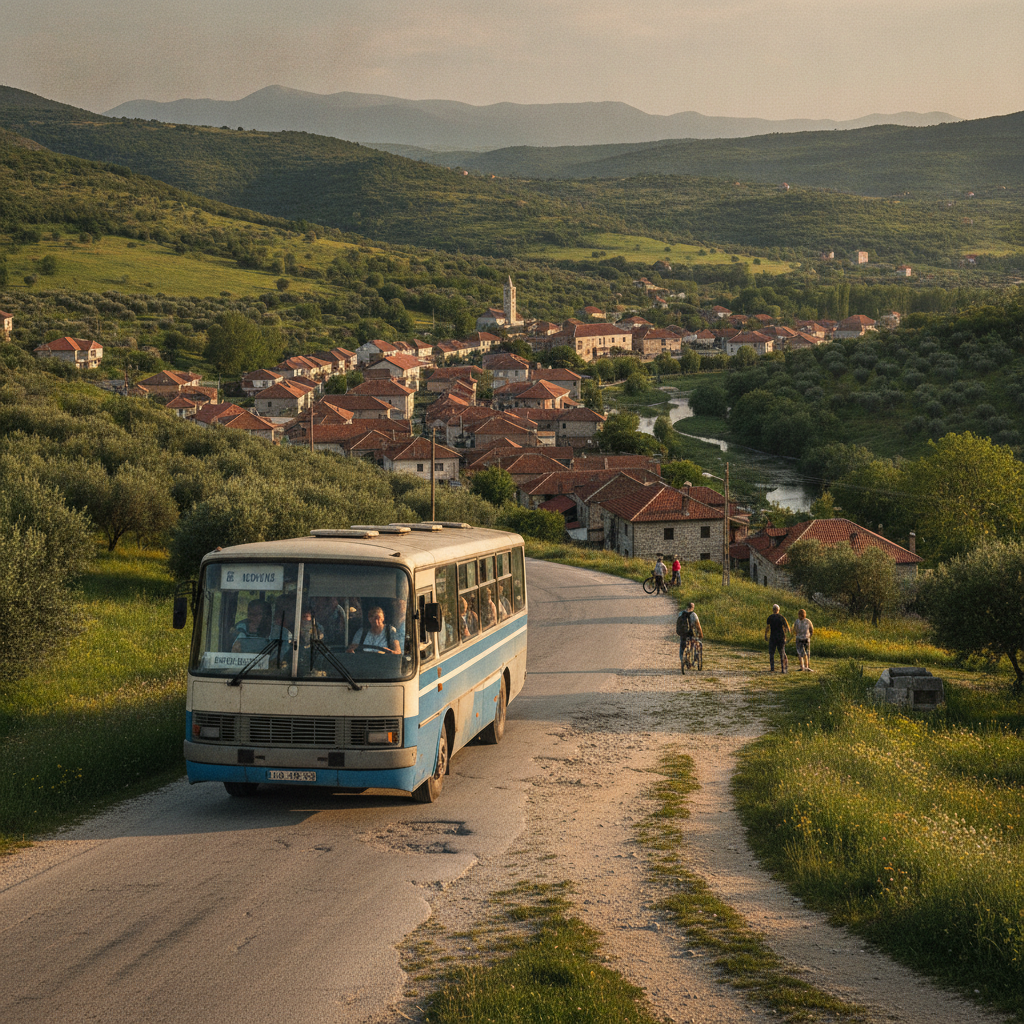
Some cultures treat hospitality as a gesture. Georgia treats it as a structure — something load-bearing, something the whole of daily life is built around and dependent upon. This distinction becomes apparent not in Tbilisi's wine bars or along the cobbled streets of Mtskheta, but in the quieter, slower places: a village in the Caucasus foothills where the road ends in gravel and the nearest town is an hour away by marshrutka. Spend a week in such a place, and the understanding of what it means to welcome a stranger shifts in ways that no guidebook manages to anticipate.
The Weight of an Open Table
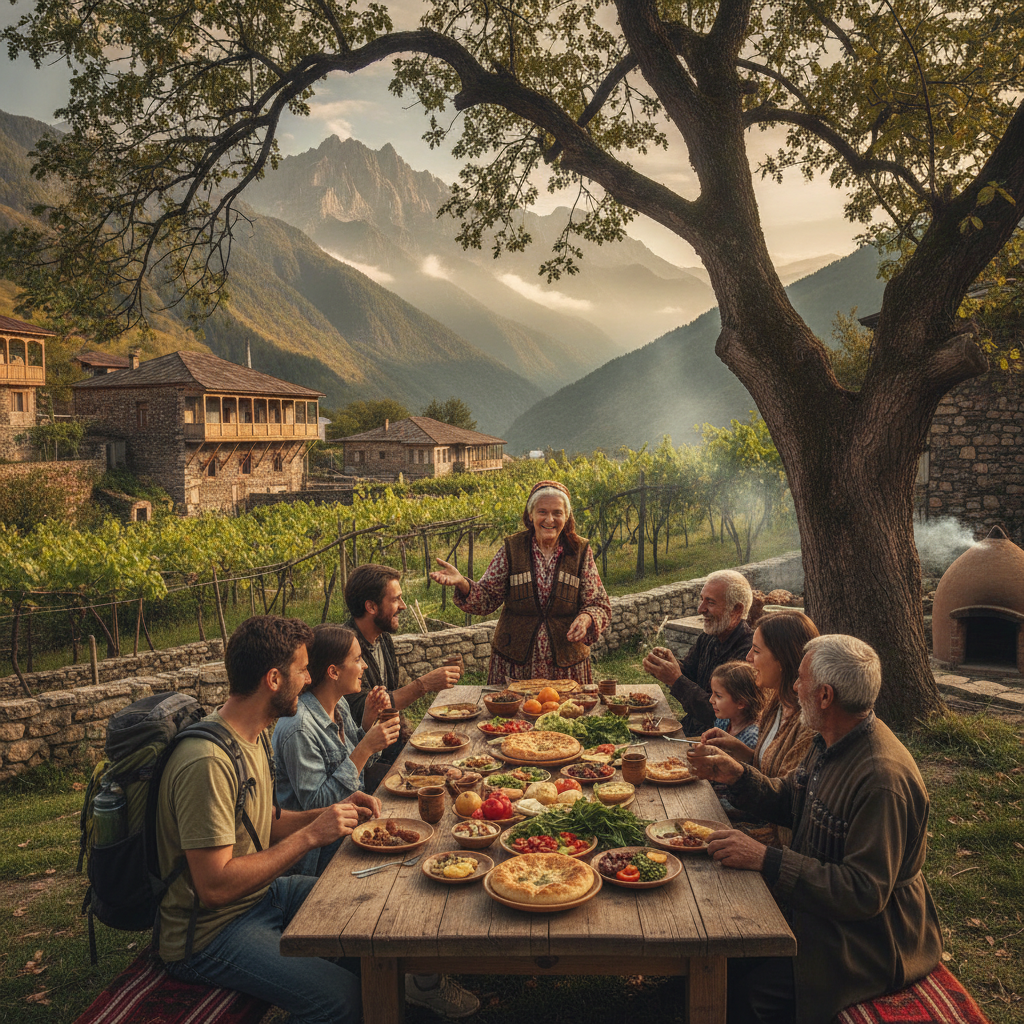
The concept of *Tamada* — the Georgian tradition of a ceremonially appointed toastmaster who guides guests through a meal — is often mentioned in travel writing as a charming custom, a footnote about wine and warm rooms. But observed up close, over multiple evenings in a single village, it reads as something closer to a social institution. The Tamada doesn't simply propose toasts; he orchestrates the emotional rhythm of the gathering, moving from gratitude to memory to hope in a deliberate sequence that gives the meal a beginning, a middle, and a close. Food in this context stops being sustenance and becomes a medium for transmission — of story, of kinship, of a community's sense of itself. Guests seated at a Georgian table are not passive recipients. They are participants in a structured ceremony whose purpose is to make the unfamiliar feel included. That alone reframes what hospitality actually means.
The table itself is a separate subject. *Supra*, the traditional Georgian feast spread, is not a single dish but an accumulation — *khinkali* dumplings, walnut-stuffed *badrijani nigvzit*, slow-cooked *chakapuli* in spring herbs, rounds of *shotis puri* bread pulled from a clay *tone* oven. What strikes a visitor most, after a few evenings, is that the abundance isn't performative. There's no sense that the family is stretching beyond its means to impress. The spread reflects a deeply held belief that the guest carries honor into the home, and that the home responds accordingly. In Svaneti or the villages above the Alazani Valley, this belief is not spoken about — it's simply enacted, repeatedly, without ceremony around the ceremony itself.
Architecture Built From Obligation and Affection
Georgian hospitality holds an interesting internal tension: it is simultaneously an obligation and a genuine expression of warmth. The Georgian word *stumarmaspindzloba* — roughly translated as the guest-host relationship — carries moral weight. To receive a guest poorly is not merely a social failure but something closer to a breach of character. Yet in practice, this obligation never feels transactional or reluctant. The obligation and the affection have been integrated for so long that they're no longer distinguishable from each other. What one observes in a mountain village over the course of a week is the result of generations of social practice becoming instinct — a community that has rehearsed welcome so thoroughly it no longer requires deliberate effort.
This architectural quality of Georgian hospitality — the idea that it shapes how space, time, and relationships are organized — becomes most visible in the small rhythms. A neighbor arrives with churchkhela, the candle-shaped walnut and grape-juice candy, not because there's an occasion but because a guest is present. The guest becomes the occasion. Mornings begin with tea offered before conversation, because the sequence matters: comfort first, talk second. Even the layout of older village homes reflects this priority, with the main room positioned to receive guests directly, centered around the hearth and the table rather than around private family space. Hospitality here isn't a room you enter — it's the organizing principle of the entire house.
What a Slow Week Reveals That a Fast Trip Cannot
A single night in a Georgian guesthouse, however generous, can be mistaken for regional charm — a pleasant cultural flavor, noted and moved past. A week in one place dismantles that easy reading. By the third day, the patterns become visible: the consistency of the welcome, the way it doesn't diminish when novelty wears off, the quiet continuity of care extended to someone who is still, technically, a stranger. Villages in regions like Tusheti or the upper Kakheti wine country offer this kind of extended encounter, where the traveler stops being a visitor passing through and becomes, temporarily, a presence within the community's normal rhythms. That shift in status reveals something no amount of research can substitute for: hospitality as it functions when no performance is required.
The practical implications for the traveler are worth sitting with. Staying in a family-run guesthouse rather than a hotel — places like those found through the Georgian National Tourism Administration's registered accommodation networks — places one inside a social logic that hotels by design exclude. Meals happen when the family eats. Introductions to neighbors occur naturally. The week accumulates texture rather than just destinations. Packing light and moving slowly through fewer places turns out to be not a constraint but a precondition for this kind of understanding. The traveler who tries to cover Sighnaghi, Mestia, and Gori in five days will collect impressions. The one who stays in one village for a week will collect something more durable.
The Guest as a Form of Gift
Georgian tradition holds that a guest is a gift from God — *stumari ghvtis mier mogzavnilia*. This is not a pleasantry. It functions as a genuine cultural orientation, one that places the act of receiving a stranger in a moral and even spiritual register. For the traveler accustomed to transactional hospitality — to service economies where welcome is a product — this reorientation is quietly disorienting. You begin to understand that you are not being served. You are being honored. And that the appropriate response is not gratitude alone but a reciprocal presence: attention, genuine conversation, the willingness to stay a little longer at the table than comfort requires.
If you find yourself in a Georgian mountain village — in Omalo, in Ushguli, in the quieter hamlets above the main tourist routes — let the week unfold without agenda. Accept the third cup of wine. Learn two or three words in Georgian and use them badly but sincerely. Understand that the slowness is not absence of activity but a different relationship with time, one in which the guest's comfort is the activity. What you carry back from such a week isn't simply a memory of good food or dramatic mountain scenery. It's a revised understanding of what it costs, and what it means, to truly welcome another person into your life — and how a culture that has built that understanding into its architecture looks, from the inside, entirely different from one that has not.
The road into a Georgian mountain village often ends where the map does, in gravel and altitude and a silence that feels earned. But the understanding that waits there — that hospitality can be a form of cultural load-bearing, something a whole way of life depends on — is precisely the kind of understanding that travel, at its most unhurried, still makes possible.