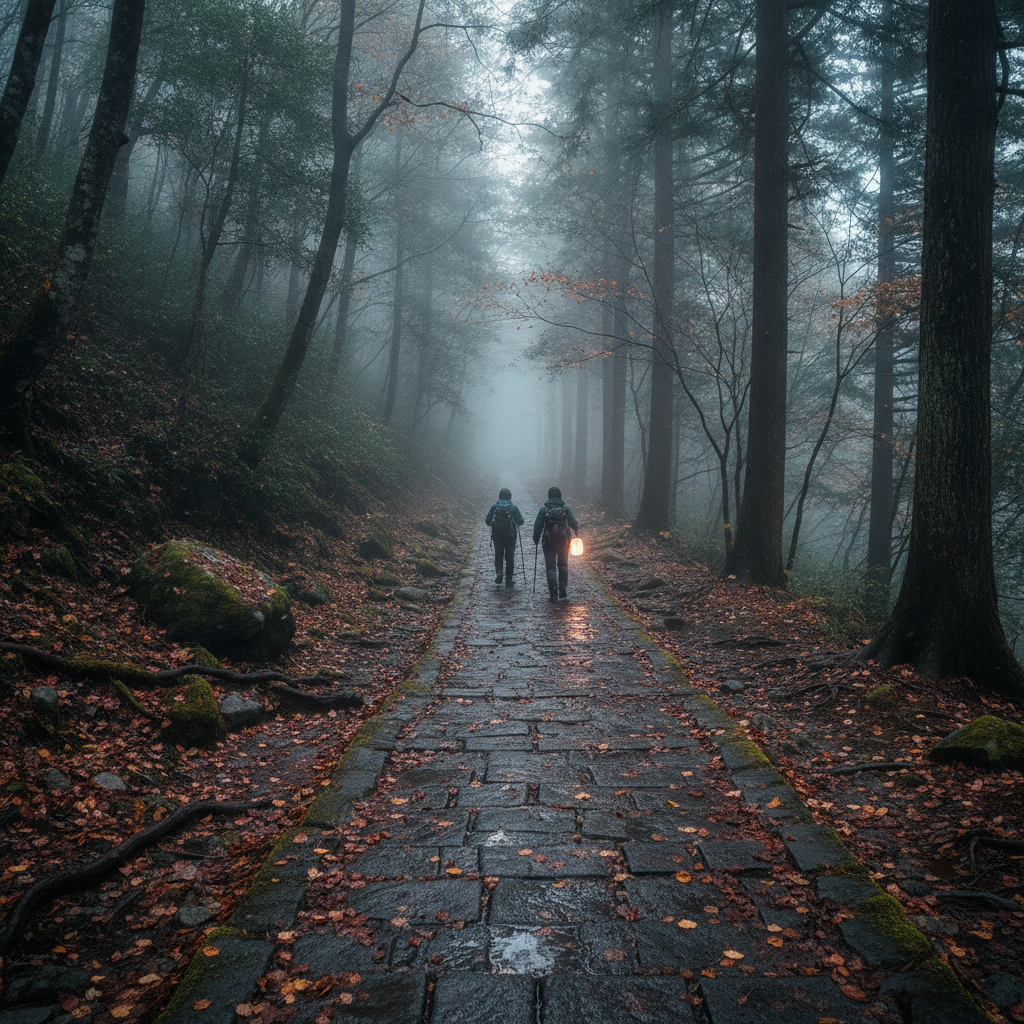
Sacred places do not hold a fixed meaning. They shift with the light, the temperature, the smell of decaying leaves underfoot, and the particular quality of silence that settles over a mountain trail when the tourist season has quietly ended and the serious walkers remain. Nowhere is this more apparent than along the Kumano Kodo, the ancient network of pilgrimage routes threading through the Kii Peninsula in Japan's Wakayama Prefecture — a place where the act of walking has been considered spiritually significant for well over a thousand years. To walk these paths in late autumn, when the maples have shed most of their color and the air carries a cold that is less hostile than clarifying, is to encounter a version of the route that most visitors never see and that no guidebook quite captures.
The Spiritual Weight of Declining Season
In Japanese cultural thought, the concept of *mono no aware* — often translated as the bittersweet awareness of impermanence — finds its most natural expression not in spring blossoms but in autumn's withdrawal. Late autumn, specifically, carries a quality that the Japanese have long associated with heightened spiritual receptivity. The trees along the Nakahechi route, which connects Tanabe to the Grand Shrines of Kumano, stand stripped of the theatrical foliage that draws photographers in October. What remains is structural: the architecture of bare branches against grey sky, the dark geometry of cedar forests, the way stone torii gates read with greater solemnity when there is nothing bright competing for attention. Pilgrims have always understood, instinctively, that a landscape asking less of the eye asks more of the interior life.
The Kumano Kodo was designated a UNESCO World Heritage Site in 2004, one of only two pilgrimage routes in the world to hold that distinction alongside the Camino de Santiago. That comparison is instructive but limited. Where the Camino unfolds across open plains and rolling hills under skies that often feel expansive and forgiving, the Kumano Kodo moves through compressed, forested mountain terrain that feels enclosed and ancient in a way that changes character dramatically with the season. In late autumn, the compression intensifies. The forest closes in not with summer's humidity but with a stillness that feels almost architectural — like walking through a long, dark hall toward something you cannot yet name.
What *Kehai* Teaches About Presence
There is a Japanese word, *kehai*, that refers to the atmospheric presence of a place or person — a kind of ambient signal the environment emits that the body registers before the conscious mind processes it. Experienced walkers on the Kumano Kodo describe the late autumn *kehai* of the route as fundamentally different from any other season. In summer, the *kehai* is alive and slightly aggressive, the forest pressing its heat and insect sound into every moment. In autumn's peak, it is theatrical. But in late autumn, after the crowds have thinned and before winter closes some of the higher passes, the *kehai* becomes contemplative — a quality of waiting, of something having just passed through. The great shrines at Hongu Taisha, Nachi Taisha, and Hayatama Taisha, the three grand destinations of the Kumano pilgrimage, feel less like tourist attractions and more like conclusions to a sentence the walk has been composing for days.
This shift in atmosphere has a practical dimension that shapes how a traveler should approach the timing of such a journey. Late autumn — broadly, mid-November through early December — offers conditions that reward those willing to dress in layers and accept unpredictable weather. Morning mist often sits in the mountain valleys until mid-morning. Rain arrives without ceremony and departs the same way. The stone paths, polished smooth by centuries of pilgrims, become slippery in ways that demand attention. That demanded attention is not incidental to the experience; it is, by the logic of the pilgrimage tradition, part of the practice. The body engaged with difficult terrain cannot easily retreat into distraction.
How Weather Becomes a Form of Instruction
The relationship between weather and sacred meaning along the Kumano Kodo is not incidental — it is structural. The pilgrimage tradition here, rooted in *Shugendo*, a syncretic practice combining Buddhist and Shinto elements with mountain asceticism, has always treated natural conditions as part of the spiritual curriculum. *Shugendo* practitioners, known as *yamabushi*, understood the mountain environment as an active teacher rather than a passive backdrop. Cold, rain, fog, and physical exhaustion were not obstacles to the spiritual journey but the medium through which it occurred. A late autumn walker who finds themselves moving through a cold mist on the Kogumotori-goe pass — one of the more demanding sections of the Nakahechi route — is participating, perhaps unknowingly, in a pedagogical tradition that stretches back to the eighth century.
This framing changes how a traveler might relate to discomfort. The instinct, shaped by modern travel culture, is to seek conditions that are comfortable and photogenic. The Kumano Kodo in late autumn offers neither reliably. What it offers instead is coherence — a sense that the difficulty of the conditions and the meaning of the destination belong to the same story. Travelers who have walked the route in October, during peak foliage season, and then returned in late November often describe the second experience as the more genuinely affecting one, even though it is objectively less visually spectacular. The colors are gone. What remains is harder to name and harder to forget.
Finding Your Own Pace on Ancient Paths
For those considering the walk themselves, the practical choices made before the journey shape everything that follows. The Tanabe City Kumano Tourism Bureau maintains detailed trail maps and condition updates, and their guidance on late autumn closures — some higher sections become impassable after early snowfall — is worth consulting carefully. Many walkers base themselves in Yunomine Onsen, one of the oldest hot spring villages in Japan, positioned conveniently near the Hongu area and offering the particular restoration that only a *yu* — a communal mineral bath — can provide after a long cold day on the trail. The convergence of physical warmth after physical difficulty, of stone-heated water after stone-paved path, is itself a kind of meaning the season makes possible.
You arrive at the trail in the grey early morning, boots already damp from dew, the smell of cedar and cold mineral earth filling every breath. The path ahead is quiet in a way that cities never quite achieve. The season has done its work — stripped the route of its easier pleasures, left only the essential ones. What the late autumn pilgrimage season along the Kumano Kodo reveals, ultimately, is that sacred landscapes do not simply exist. They are made, remade, and deepened by the conditions under which they are encountered. The meaning a place holds is not fixed in its stones or its shrines but in the particular quality of attention the weather teaches you to bring.