Every year, with a patience that has outlasted empires and redrawing of maps, the Mekong River rises. It spills across the low-lying plains of southern Vietnam in a slow, deliberate surge that local people call *mùa nước nổi* — the season of rising water. To an outsider passing through, it might appear as disruption, even catastrophe. Roads disappear beneath brown currents, rice paddies merge with the horizon, and wooden houses seem to float free of the earth entirely. But to the communities of the Mekong Delta, this annual inundation is not a problem to be solved. It is a rhythm to be lived, a calendar to be followed, and, in a very real sense, a mirror held up to who they are.
When the River Becomes the Road
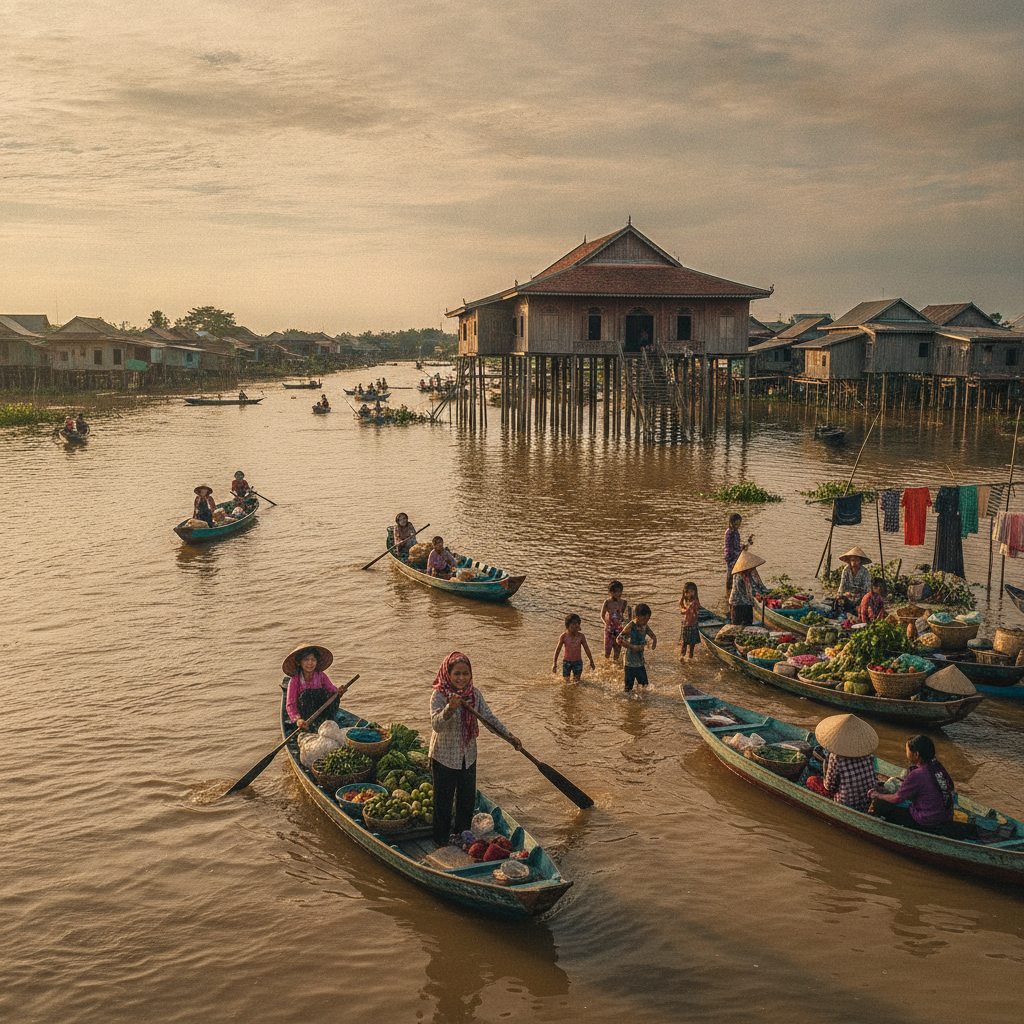
During *mùa nước nổi*, which typically peaks between August and November, the delta's network of waterways transforms from background feature to primary infrastructure. Long-tail boats replace motorcycles as the most practical form of transport between villages. Markets relocate to floating platforms. Children paddle to school in narrow wooden vessels the width of a single seat. The town of Châu Đốc, situated near the Cambodian border at the confluence of several major channels, becomes a hub of this amphibious life — its stilt houses rising just above the water line, its fish farms swelling with the season's bounty. What might initially read as improvisation is, in fact, deeply practiced adaptation, refined across generations into something that functions with remarkable elegance.
The delta's residents have developed what anthropologists describe as an *amphibious culture* — a way of organizing daily life that treats land and water not as opposites but as interchangeable terrain. This orientation shapes architecture, agriculture, commerce, and social life simultaneously. Houses are built on stilts or pontoons. Calendars are structured around the water's movements rather than fixed administrative dates. Children learn to read the river's color and current the way children elsewhere learn to read weather. The result is a community identity that is inseparable from the hydrological cycle itself — a sense of self rooted not in resistance to the environment but in profound alignment with it.
The Economy That Rises With the Flood
Floodwaters in the Mekong Delta carry more than sediment. They bring fish. During the inundation, species migrate in extraordinary numbers across the temporarily submerged plains, and local fishing reaches its most productive peak. Communities that might otherwise rely on rice cultivation through the dry months pivot decisively toward aquaculture and freshwater fishing during *mùa nước nổi*. This seasonal economic shift is not improvised each year — it is anticipated, planned for, and celebrated. Fishing gear is repaired and readied. Family boats are retrieved from storage. Recipes for snakehead fish, catfish, and prawn dishes that only appear during this window circulate between households as reliable seasonal markers.
Along the waterways near Long Xuyên and Cần Thơ, floating markets like Cái Răng have operated for generations as both commercial hubs and cultural anchors. During the flood season, their importance intensifies. Vendors navigate their heavily laden boats through channels that are, for a few months each year, broader and deeper than usual, creating a temporary geography that the markets adapt to with practiced ease. The economic calendar of the delta is, in this sense, a water calendar — one that redistributes labor, income, and community energy in ways that the fixed infrastructure of dry-land economies simply cannot replicate.
Identity Carried on the Current
What makes the Mekong Delta's relationship with flooding particularly striking is the degree to which *mùa nước nổi* has become a source of regional pride rather than collective anxiety. This is not universal across flood-affected communities in Southeast Asia — in many places, inundation is experienced primarily as loss. The delta's communities have arrived at something different: a cultural narrative in which the flood is protagonist, not antagonist. Festivals are held at the water's height. Songs and folk poetry reference the smell of river mud and the sound of rain on corrugated tin roofs as markers of home and belonging. The seasonal flood is woven into the emotional vocabulary of the region.
This orientation has practical consequences for how communities engage with outside interventions. Proposals to build higher dikes or install flood control infrastructure — many of which have been implemented in parts of the delta over recent decades — are received with ambivalence by longtime residents. The concern is not only ecological, though that dimension is real and significant. It is also cultural. To fully suppress the flood is, in the eyes of many local people, to suppress something essential about the way life in the delta has always been organized and understood. The water is not merely a resource or a hazard. It is a carrier of meaning.
What Traveling Here in Flood Season Offers
For travelers willing to time a visit to the delta's inundation months, the experience available is categorically different from what dry-season itineraries provide. The landscape itself changes character — flatter, wider, more reflective, and oddly quieter in places where the usual sounds of road traffic give way to the dip of paddles and the distant chug of boat engines. Guesthouses in Châu Đốc and the surrounding villages sometimes offer boat trips specifically designed around flood-season geography, moving through stands of submerged trees and over fields that will return to rice production once the waters recede. These journeys offer a spatial understanding of the delta that no dry-season visit can replicate.
If you visit during *mùa nước nổi*, the most rewarding approach is to slow down and follow local rhythms rather than a fixed itinerary. Take a boat to a floating market at dawn. Eat at a family-run kitchen where the menu changes weekly based on what the river is producing. Accept that some roads will be impassable and that this is not a failure of planning but an invitation to travel by water instead. The delta does not ask visitors to conquer it. It asks them to move with it — which, as its communities have known for centuries, is a far more interesting way to go.
The same scene that opens every flood season — brown water spreading quietly across the low-lying plain, houses appearing to float, children paddling toward school — contains within it an entire philosophy of belonging. The Mekong Delta does not separate its people from their environment and then ask them to manage the consequences. It places them inside a living system and asks them to become fluent in its language. That fluency, built across generations and expressed in everything from boat design to festival timing to the precise way a fisherman reads the current, is what community identity looks like when it grows from water rather than despite it.