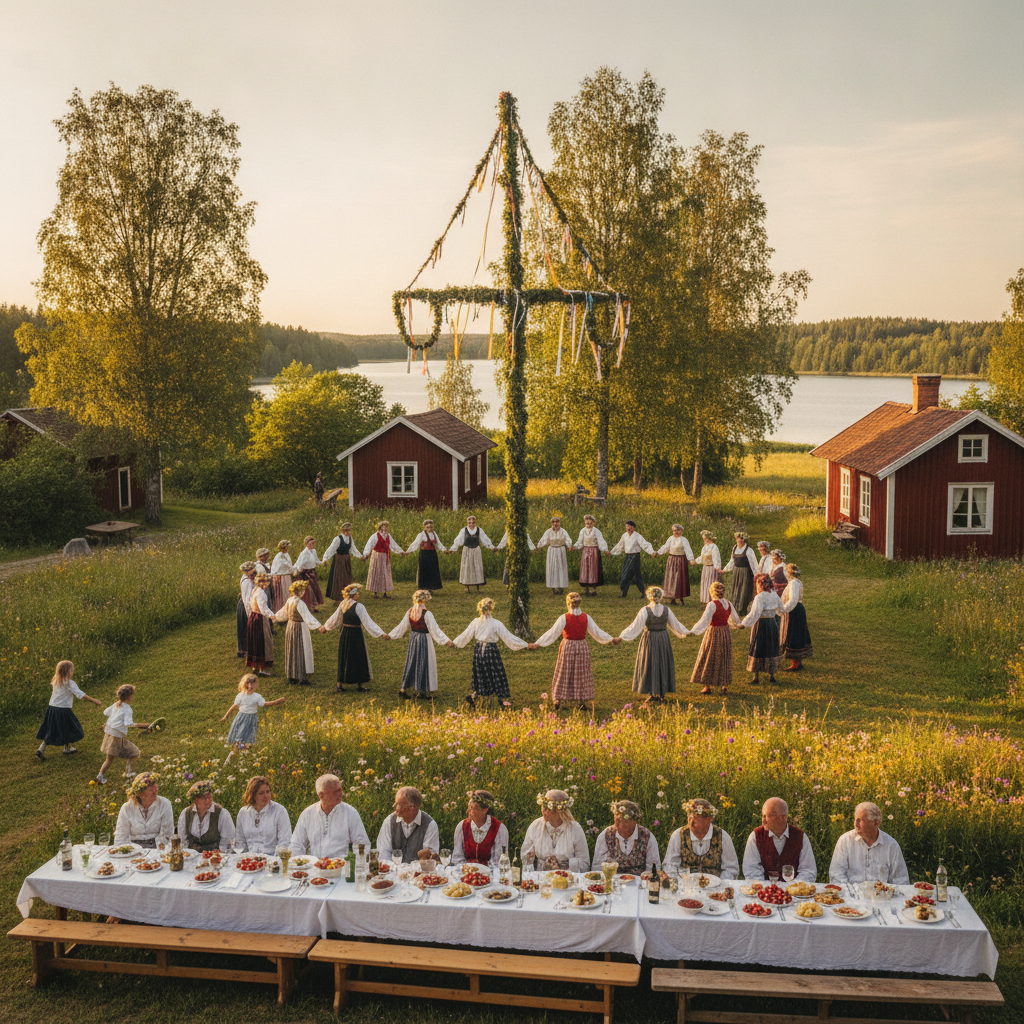
Light, in sufficient abundance, changes human behavior in ways that are profound and surprisingly consistent across cultures. Nowhere is this more visible than in rural Sweden during the weeks surrounding Midsommar — the traditional midsummer celebration that falls closest to the summer solstice — when communities that have lived quietly and separately through nine months of darkness suddenly orient themselves toward one another with an almost magnetic intensity. The fields turn luminous, the nights refuse to surrender to darkness, and something old and unspoken reasserts itself in the way people gather, move, and share ground. For a traveler willing to step away from the organized festival circuits of Stockholm or Gothenburg and into the slower rhythms of places like Dalarna or the archipelago villages east of Västerås, midsummer becomes less a tourist event and more a lesson in how light itself functions as a social architect.
The Geography of Long Light
Above roughly the 60th parallel, the summer solstice produces a phenomenon that resists easy description until you experience it firsthand. Twilight and dawn overlap into a single, continuous amber haze that renders sleep approximate and time elastic. In the Dalarna region — widely considered the heartland of Swedish folk tradition — this extended light does not simply extend the day; it reorganizes the emotional and social calendar of entire communities. Farmers who in February maintain a kind of respectful distance across snow-covered fields become, by June, neighbors in the fullest sense of the word. The physical fact of shared daylight seems to lower the threshold for collective action, nudging people toward the maypole, toward the lakeside, toward one another. This is not nostalgia performed for visitors. It is a living recalibration that happens regardless of whether cameras are present.
Midsommarstången and the Logic of the Center
The midsommarstången — the midsummer pole, a tall wooden cross draped in birch leaves and wildflowers — is the clearest physical expression of this social reorganization. Every village erects one, and the act of raising it is genuinely communal: neighbors gather not to watch but to participate, pulling ropes, steadying crossbeams, weaving garlands from whatever grows in the surrounding meadows. The pole functions as a focal point around which the diffuse energy of the season becomes legible. Traditional dances like Små Grodorna — a playful frog-imitation song danced in rings — seem almost embarrassingly simple until they are experienced in a field at eleven o'clock at night beneath a sky that is still pale gold, surrounded by several generations of the same extended community. Then they feel like exactly the right language for what the light is doing to everyone present.
The meaning of shared space is altered by the presence of the pole not because of any mystical property, but because it gives the gathering a reason to occupy the same ground simultaneously. In everyday rural life, that kind of convergence requires an occasion. Midsommar is the occasion that the calendar and the sky conspire to create every year, reliably and without negotiation.
How Daylight Becomes a Social Architecture
Urban festivals operate differently. They require infrastructure — stages, barriers, ticketing systems, scheduled start times — because the city's default condition is noise and movement, and a festival must cut through that ambient energy to register as distinct. Rural midsummer in Sweden requires almost none of this because the light itself does the organizational work. The absence of darkness removes the usual cues that signal the end of a social gathering: the cooling air, the dimming sky, the sense that the evening has peaked. Without those cues, time stretches generously, and communities settle into the shared space rather than moving through it on a schedule. This is one of the more quietly radical things the season reveals — that many social boundaries are enforced not by choice but by darkness, and that their removal produces a fundamentally different quality of togetherness.
Villages like Leksand in Dalarna and the smaller settlements scattered across Hälsingland have maintained midsummer rituals that are remarkably consistent in structure across generations precisely because the light that anchors them is itself consistent. The solstice is the most dependable event in the human calendar, and the rituals built around it carry that dependability in their bones.
What the Traveler Actually Encounters
For the traveler, arriving in rural Sweden during midsummer week without a structured itinerary is an education in presence. The practical advice most guidebooks offer — book accommodation months ahead, rent a bicycle, avoid the tourist-facing events in major cities — is sound, but it misses the deeper orientation shift that the experience requires. The goal is not to witness the festival but to become temporarily permeable to its logic. That means accepting invitations when they come, understanding that the herring and new potatoes served at almost every midsummer table are not incidental but deeply symbolic of seasonal eating tied to Swedish agricultural memory, and recognizing that the schnapps songs — known as snapsvisor — sung before each small glass are a kind of communal punctuation, a way of marking shared pleasure with collective voice.
The most valuable preparation a traveler can do is not logistical but attitudinal: arriving willing to slow down to the pace the light creates, rather than moving through the season at the speed of a conventional tour.
Finding Your Own Orientation
When you stand in a Swedish meadow at midnight in late June, watching a sky that refuses to darken, something shifts in your sense of what a day is and what it owes you. The anxiety of scheduled time dissolves, not because you've abandoned responsibility, but because the environment has temporarily suspended the visual cues that enforce it. Communities built around this experience year after year have developed a cultural fluency with shared space that is worth studying not just as folklore but as a model for how humans can organize themselves around natural phenomena rather than against them. Seek out the smaller villages rather than the curated experiences. Stay long enough that the light begins to feel normal. Let the midsommarstången be a pole and not a photo opportunity, and the season will return something to you that ordinary travel rarely reaches.