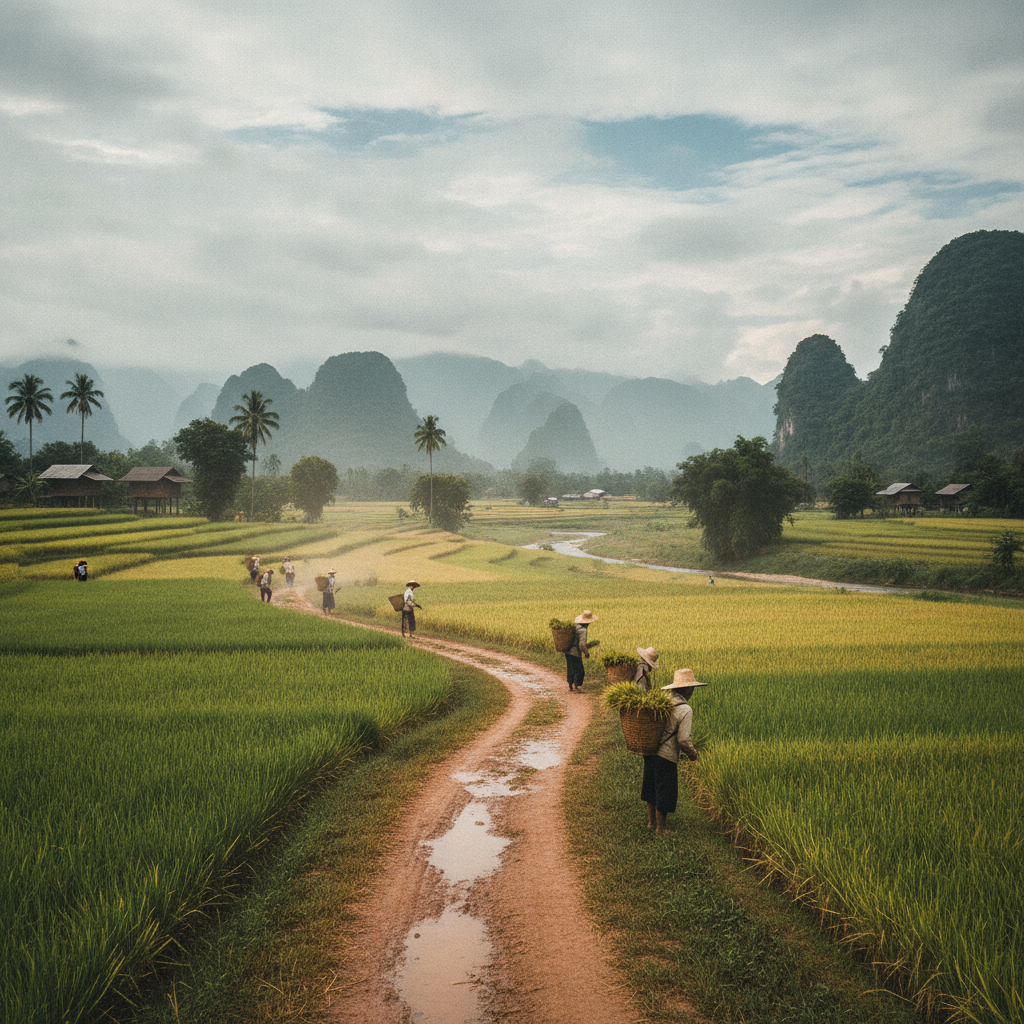
Weather does not merely set the backdrop for travel — it authors the experience itself, scripting the pace of daily life, the mood of the markets, and the emotional register of every encounter along the way. Nowhere is this more legible than in northern Laos, during the weeks when the monsoon loosens its hold on the mountains and something quieter, cleaner, and profoundly different begins to settle across the valleys. The shift is not dramatic in any cinematic sense. There are no sudden storms giving way to brilliant skies on cue. Instead, it arrives the way most meaningful transitions do: gradually, incompletely, and with a texture that rewards attention over spectacle.
The Weight That Lifts When the Rains Begin to Ease
For months, the highland landscape around Luang Prabang absorbs rainfall in volumes that reshape the land visibly — rivers thickening and lifting toward their banks, hillside paths softening into mud, the air heavy with a warmth that feels almost solid. The Mekong runs swollen and brown, carrying silt from hundreds of tributaries upstream. This is the season of *pansa* — the Buddhist Rains Retreat, a period when monks remain within their temples and community life folds inward, slowing to match the weather. Farmers work in their paddies through the wettest months, planting and tending rice that will sustain entire villages through the year ahead. The monsoon is not endured; it is incorporated. And when it begins to recede — usually through October, with the transition deepening into November — it leaves the landscape visibly altered, greener and more voluminous than anything a traveler from a temperate climate might expect from a season's end.
The physical transformation that follows is genuinely striking. River levels drop gradually, revealing sandbanks and rock formations that remain submerged for the better part of half a year. The air begins to carry a clarity that sharpens the outlines of the mountains, those forested ridgelines that encircle Luang Prabang on all sides becoming newly distinct against a sky that deepens from grey to a clean, unhurried blue. Temperatures ease from the humid heaviness of the wet season into something cooler in the mornings — cool enough, in the mountain villages above Nong Khiaw, to warrant a light layer before sunrise. This cooling is not incidental. It restructures the day itself, inviting earlier rising and longer evenings, two conditions that alter how a traveler occupies both time and space in ways that a guidebook rarely anticipates.
How Climate Writes Itself Into Ritual and Routine
What becomes apparent during this transitional period is that the rhythms of northern Lao life are not simply adapted to the weather — they are organized around it with a precision that centuries of close observation have refined into something approaching elegance. The end of *pansa* is celebrated through *Awk Pansa*, a festival that marks the monks' return to movement and community engagement, often accompanied by illuminated boat processions on the river. Timing the trip to overlap with this period means witnessing something that is not staged for visitors — it is a genuine recalibration of communal life, a collective exhale after months of inward focus. The markets shift too. Vendors who traded in rain-season produce — wild mushrooms, particular river greens, fermented preparations that suit the wet heat — begin to offer different things as the weeks progress and upland foragers adjust their routes to drier ground.
The agricultural calendar becomes newly visible in these transitional weeks. In the valley fields near Muang Ngoi and along the Nam Ou river corridor, rice harvesting begins once the paddies have had time to ripen and the soil has firmed enough for the work. The harvest is communal in character, with families moving between fields and sharing labor in arrangements that have their own name and protocol, reflecting a social architecture built directly on the seasonal demands of the land. A traveler passing through during this window catches a form of collective industriousness that is rarely performed and never particularly curated — it simply proceeds, purposefully, around and occasionally through whatever visitors happen to be present.
Reading a Place Through Its Seasonal Seams
There is a particular kind of understanding available to those who arrive during transitional periods rather than at peak season's height. The travel infrastructure of northern Laos — the slow boats on the Mekong between Huay Xai and Luang Prabang, the guesthouses clustered in towns like Muang Sing and Phongsali — operates differently as the tourist season rebuilds its momentum after the monsoon's quieter months. Guesthouses that were sparsely occupied through the rains begin to fill, but haven't yet reached the density of December and January. This creates an in-between quality of access: places are open and welcoming, staff are attentive without being overwhelmed, and the sense of having a destination to oneself — however briefly — hasn't yet entirely dissolved.
For a traveler paying attention, the transition itself becomes the subject rather than merely the context. The particular smell of the air after a final overnight rain, the way golden light falls differently through drier atmosphere onto the temple rooftops of the old town, the shift in birdsong as species that favor open canopy return to areas where flooding had reduced them — all of it is information about what this place fundamentally is, read not through a lens of tourism but through the lens of ecology and time. Weather, understood this way, is not something that happens to a destination. It is, in a meaningful sense, the destination.
When you arrive in northern Laos during that suspended, luminous stretch between the monsoon's last rains and the dry season's full arrival, something shifts in how travel itself feels. The usual logic of sightseeing — moving efficiently between catalogued attractions — becomes less compelling than simply standing still and watching a place exhale. The monks walk at dawn as they always have, their saffron robes vivid against stone paths still dark from the night's dew. The mountains reappear through clearing mist. The river finds its new level and settles. And the traveler, if they're paying the right kind of attention, finds that the weather hasn't just shaped the character of northern Laos — it has quietly shaped the character of the journey itself, the same way it shaped the scene at the very beginning, before the maps came out and the planning began.