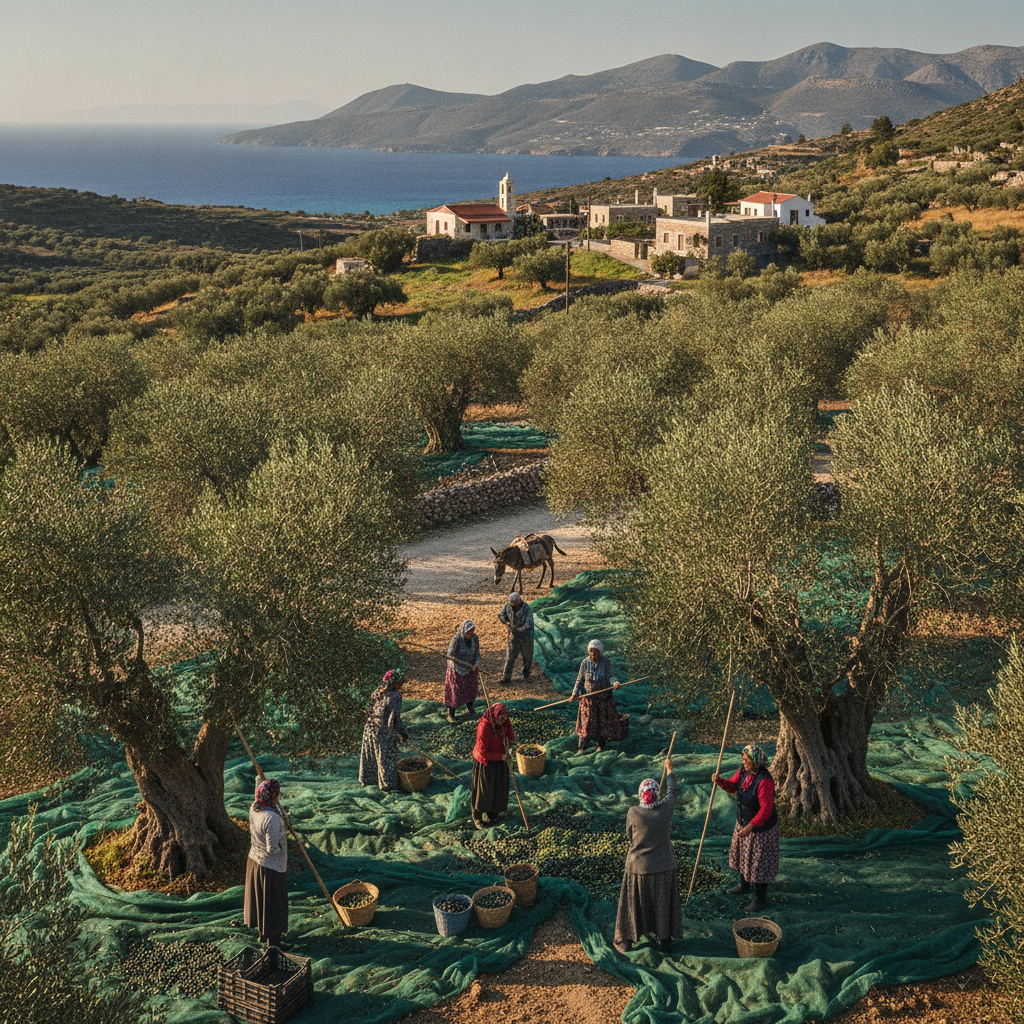
Certain landscapes carry their identity in layers — in the soil, in the arrangement of stone walls, in the particular angle of light through an ancient canopy. In rural Crete, few things reveal the depth of this layering more completely than the arrival of the olive harvest season. Each autumn, across the Messara Plain and the groves climbing toward the White Mountains, something shifts in the rhythms of everyday life that goes far beyond agriculture. Communities that spend most of the year operating at their own quiet pace suddenly reorganize themselves around a shared task, and in doing so, they make visible a cultural architecture that has been standing for centuries.
The Harvest as a Social Structure
The Cretan olive harvest — known locally as *mαζεύω ελιές*, or the gathering of olives — typically runs from late October through January, varying by altitude, microclimate, and olive variety. The dominant cultivar across the island is the Koroneiki, a small, intensely flavored olive prized for the rich oil it yields. Harvesting Koroneiki olives is labor-intensive work that has never fully yielded to mechanization in the traditional groves, where trees grow old and gnarled on terraced hillsides that no machine can easily reach. Families return from cities, relatives arrive from other villages, and the social calendar of the community quietly restructures itself around the grove. What emerges is less a work schedule than a communal institution — one that requires cooperation, trust, and a shared understanding of timing that is passed between generations without formal instruction.
In villages near Rethymno and in the mountain settlements above Heraklion, the harvest period functions as a kind of annual reunion that the agricultural calendar imposes with more authority than any planned event could. Extended families who might otherwise connect only at Easter or for weddings find themselves working side by side for weeks, sharing meals under the olive trees, debating which trees need attention, and making decisions that will shape next season's yield. The work itself — spreading *τελάρα* (large nets) beneath the branches, using long-handled rakes to coax the olives free, collecting them by hand from the nets — creates a physical intimacy with the land that no other seasonal activity quite replicates. Children learn the work by watching and then doing, absorbing not just technique but the unspoken understanding that this grove, and its care, belongs to them as much as it belongs to anyone.
What the Grove Teaches About Time
Olive trees in Crete are not young. Many of the working groves contain trees that are several hundred years old, their trunks twisted into forms that seem almost architectural. Working among them gives the harvest a quality that modern agricultural contexts rarely carry: a sense of continuity with something genuinely ancient. The same trees that a family harvests now were harvested by their great-grandparents, and possibly by people whose names have been forgotten entirely. This relationship with deep time is not merely sentimental — it shapes how communities understand their own identity. The grove is both a productive asset and a form of collective memory, and caring for it correctly is understood as an obligation that extends backward and forward in time, not just into the current season.
This orientation toward long cycles is visible in how Cretan olive growers talk about their work. A tree that produces heavily one year will often rest the following year, a pattern called *παρενιαυτοφορία* (alternate bearing), which growers have observed and planned around for generations. Managing this rhythm requires patience — not the patience of waiting for a short-term result, but the patience of a person who understands that the relevant timeline is longer than a single life. Visitors who spend time in these communities during the harvest often find this perspective quietly disorienting, in the best possible sense. The pace of the work, the conversation, and the decision-making all seem calibrated to a different clock than the one most contemporary life runs on.
Olive Oil, Identity, and the Economics of Care
The oil produced from these traditional Cretan groves carries a designation — *εξαιρετικό παρθένο ελαιόλαδο*, or extra virgin olive oil — that legally requires low acidity and careful handling from grove to mill. In practice, the quality of the oil depends enormously on how quickly harvested olives reach the press. Cretan growers tend to be meticulous about this, transporting their harvest to local cooperatives or private mills — such as those found operating around the Kolymvari region on the northwestern tip of the island — within hours of picking. The result is an oil with flavor characteristics that reflect the specific microclimate and soil of the grove, a concept the food world now calls *terroir* but that Cretan producers have understood implicitly for far longer than the term has existed.
The economic dimension of the harvest is real and significant — olive oil remains one of the primary income sources for rural Cretan households — but reducing the harvest to its economic function misses what it actually does within the community. The harvest is where social debts are settled and accumulated: neighbors who help one family this week expect reciprocal labor next week. Young people demonstrate competence and earn respect from elders. Disputes that have simmered through the year sometimes find resolution in the shared effort of difficult physical work. The grove, in this sense, is not just a place where olives are grown. It is a place where community is continuously produced and renewed.
Traveling Through the Harvest Season
For those drawn to this kind of experience, timing a visit to rural Crete during the harvest months requires some deliberate planning. The period from November through December tends to offer the most visible activity across the inland villages, particularly in the areas around Archanes and the foothills of Mount Ida. Accommodations in small agrotourism properties — some of which offer working participation in the harvest — fill early, and the rhythm of village life during this period is genuinely different from the summer tourist season. The tavernas are quieter, the conversations slower, and the sense of being inside something real, rather than adjacent to a performance of culture, is palpable.
If you travel during this season, the most rewarding approach is to slow down enough to let the pace of the harvest set yours. Visit a local cooperative mill during pressing hours, where the smell of fresh oil is almost overwhelming in its richness. Spend time in a village square in the late afternoon, when the day's work is done and the conversation turns easy. Try *dakos* — the Cretan barley rusk topped with fresh tomato and local oil — made with oil pressed that same week. These are not tourist experiences in any constructed sense. They are simply what life looks like here, in this season, in this particular rhythm that the land has imposed for as long as anyone can remember.
The olive grove that stands weathered and ancient on a Cretan hillside in November is, in a sense, the same grove it was at the beginning of the article — rooted, patient, and indifferent to the passage of individual seasons. What changes, year after year, is only the people moving through it: the children who grow into adults, the elders who pass their knowledge quietly along, the families who return and return again because the grove will not wait, and because waiting is beside the point. The harvest does not ask whether community identity is still a meaningful concept in an era of dispersal and distraction. It simply arrives, as it always has, and the people come.