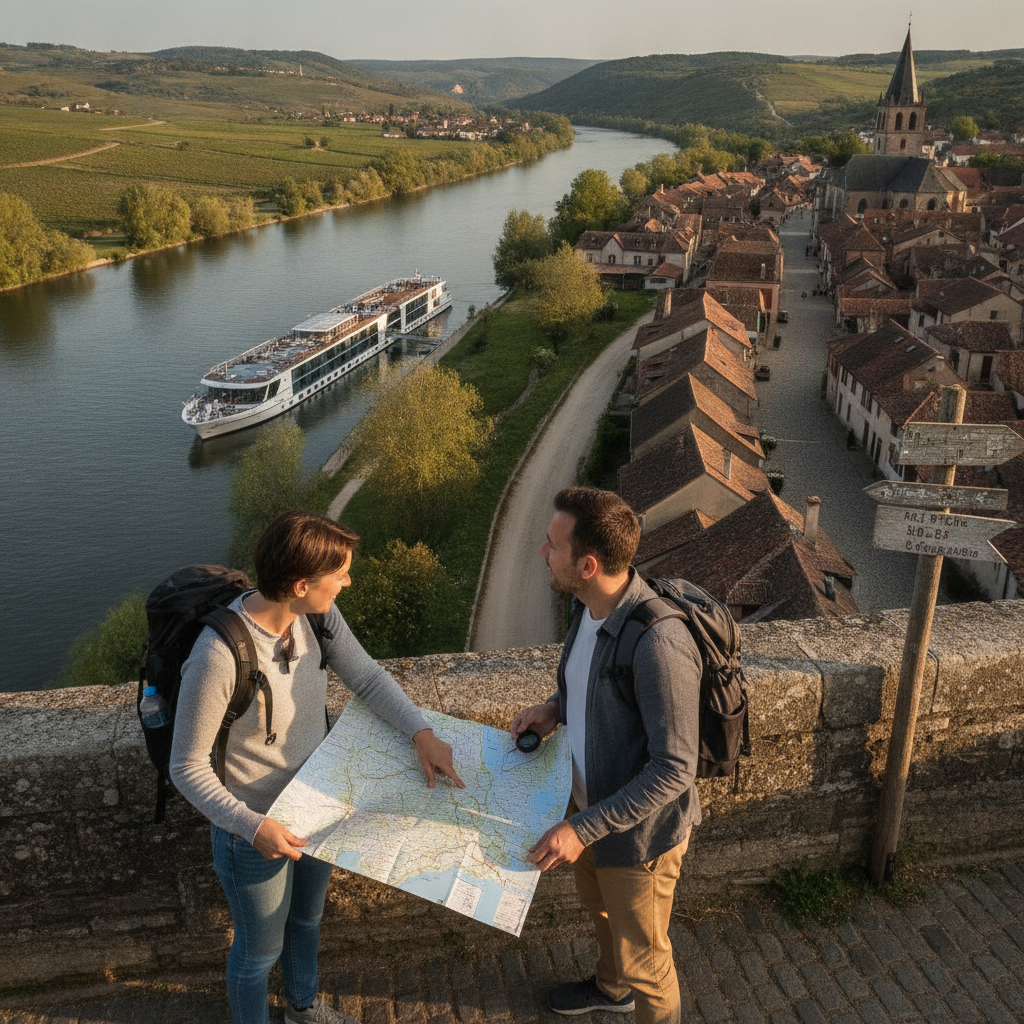
River cruise routes have always known something that independent travelers are slower to discover: the most revealing way to understand Europe is to follow its water. Long before railways or motorways stitched the continent together, rivers were the arteries of commerce, culture, and migration. The Rhine carried wine and wool; the Danube served as a border, a highway, and a lifeline for a dozen civilizations. What the cruise industry figured out — almost accidentally — is that these ancient corridors string together some of the most historically layered, architecturally rich, and culturally underexplored towns on the continent. The traveler who uses those routes not as a booking template but as a geographic and cultural map gains something far more valuable than a curated deck-top view.
The Logic Behind River Corridor Travel
River cruise itineraries are, at their core, carefully researched geographic sequences. Companies like Viking River Cruises and Avalon Waterways have spent decades refining which towns are worth stopping in, which tributaries offer the most cultural contrast, and how much time each destination genuinely warrants. The independent traveler's insight is to borrow this research without booking the ship. A classic Danube itinerary, for instance, moves through Passau, Linz, Krems, and Vienna before continuing into Slovakia and Hungary — a sequence that no standard rail pass map would naturally suggest. Each of those stops carries distinct architectural character, culinary traditions, and a pace of life that shifts noticeably from one bank to the next. Following the water by train, bus, or rental car allows for the kind of lingering that a one-night ship stop simply cannot offer.
The Moselle Valley, which winds between Germany and Luxembourg before joining the Rhine at Koblenz, is a particularly instructive example. Cruise operators favor it for its steep vineyard terraces and medieval villages, but the region rewards those who arrive by bicycle or slow regional train and stay for several nights in a *Winzerhaus* — a winemaker's guesthouse, typically family-run and attached to an estate. These accommodations sit outside the range of most guidebooks and rarely appear in aggregator searches, yet they offer an intimacy with place that no hotel category can replicate. The rhythm of a river valley town — market mornings, quiet afternoons, communal evenings — only becomes legible when one has time to observe it repeating.
Reading the Itinerary as a Cultural Map
Beyond geography, river cruise itineraries encode cultural logic that the attentive traveler can decode. The towns chosen are rarely the most famous; they are often the most representative. A ship stopping in Český Krumlov on the upper Vltava isn't simply offering a pretty castle view — it's pointing toward a region of Bohemia that resisted industrial development and retained a medieval urban form that survived the twentieth century largely intact. Similarly, stops along the Rhône between Lyon and Arles trace the boundary between northern French reserve and Mediterranean expansiveness, a distinction that manifests in everything from architecture and cuisine to the speed at which strangers make eye contact. Understanding this layer — the *genius loci*, or spirit of place, as classical writers called it — turns a list of port towns into a coherent cultural journey.
The practical method is straightforward. Take any published river cruise itinerary — freely available on operator websites — and treat the port list as a research brief. For each town, look beyond the attraction highlights toward the local markets, the surrounding villages, the nearest train connections, and the seasonal events that draw residents rather than visitors. The Wachau Valley wine harvest in Austria's Lower Austria region, for example, is a genuine community event that happens to coincide with the period when cruise ships are also passing through. Arriving independently during that window, staying in the valley rather than in Vienna, and attending the *Weinlese* — the grape harvest — alongside locals is an experience with an entirely different character than a shore excursion.
Slowing Down Where the Ships Speed Past
The most significant advantage the independent traveler holds over the cruise passenger is time. A river ship might dock in Regensburg for six hours, enough to walk the stone bridge, eat a *Wurstkuchl* sausage at the oldest sausage kitchen in Germany, and browse the cathedral. What it cannot do is linger into the evening when the students from the university fill the narrow lanes of the Altstadt, or take a morning train to Weltenburg Abbey — a Baroque monastery set in a dramatic gorge where the Danube cuts through limestone cliffs — and spend an afternoon that belongs entirely to the quiet and the river light. These are the hours that form lasting impressions, and they require no special planning, only the willingness to slow the pace below what an itinerary demands.
Using tools like Rome2rio for routing between river towns and apps like Komoot for cycling the towpaths that parallel most major European waterways, the independent traveler can approximate the geographic sequence of a cruise while setting an entirely different tempo. Accommodation in smaller river towns — a *Pension* in the German tradition, or a chambres d'hôtes in France — runs considerably less expensive than equivalent quality in capital cities, which makes the slower pace financially sustainable as well as experientially richer.
Bringing the Framework Home With You
When you begin planning a trip this way — river first, towns second, sights third — something shifts in how the journey feels from the inside. You stop moving toward landmarks and start moving through regions, which is an older and more rewarding way to travel. Choose one river corridor: the Rhine, the Danube, the Dordogne, the Douro in Portugal. Download a cruise operator's itinerary for that route and read the port descriptions not as sales copy but as geographic journalism. Then build your own sequence, slower and freer, staying two or three nights where the ship stays two hours. Book the winemaker's guesthouse, take the regional train, eat where there's no English menu outside. The river cruise industry, for all its comforts, has quietly done the curatorial work for you. What it cannot do is give you the time to actually inhabit the places it has found — that part remains yours to claim.
The old European rivers are still flowing the same courses they carved through the continent long before any traveler thought to follow them. The water doesn't know the difference between a cruise passenger on a deck and a traveler at a café table in a town the brochure only mentioned briefly. But the traveler will.