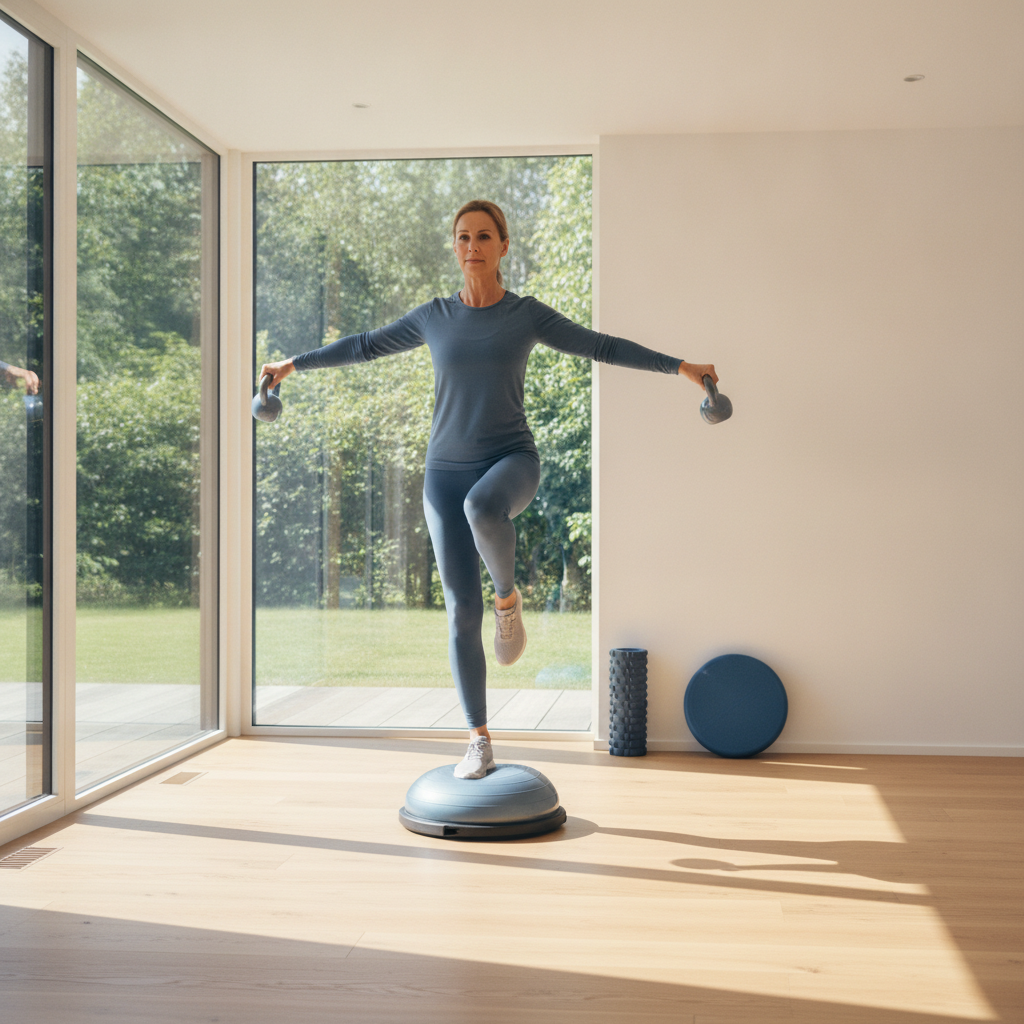
The human body's ability to sense its own position in space is something most people take entirely for granted — until it starts to quietly erode. Proprioception, the internal feedback system that allows muscles, joints, and the nervous system to coordinate movement without conscious effort, begins a measurable decline in the fourth decade of life. What makes this decline particularly insidious is that it rarely announces itself dramatically. Instead, it shows up as slightly slower reflexes, a momentary wobble on uneven ground, or a subtle hesitation when stepping off a curb in the dark. Addressing it before it compounds is both practical and achievable.
What Proprioception Actually Does in the Body
Propioception operates through a network of sensory receptors embedded in muscles, tendons, and joint capsules. These receptors — called mechanoreceptors — continuously send information to the central nervous system about the body's orientation, velocity, and load. The brain uses this constant stream of data to make micro-adjustments that keep movement fluid and efficient. When proprioceptive function is strong, these adjustments happen automatically. When it weakens, the margin for error narrows, and the risk of falls, sprains, and compensatory injuries rises. Think of it less like a single skill and more like a background process running constantly beneath every movement.
Why Decline Accelerates Sharply After Forty
Research consistently points to the decade between forty and fifty as a turning point in proprioceptive function. The mechanoreceptors themselves become less sensitive over time, while the neural pathways that transmit their signals slow in conduction speed. Muscle spindles — the receptors most directly responsible for detecting changes in muscle length — lose some of their responsiveness as muscle mass decreases with age. Hormonal shifts, reduced physical variety in daily movement patterns, and a general narrowing of movement complexity all compound this. People who have spent years in sedentary office environments often arrive at fifty with proprioceptive systems that have been largely underused for a decade or more.
How Single-Axis Stability Exercises Target the Right Systems
Single-axis stability exercises work by isolating movement challenges along one plane at a time — forward-backward, side-to-side, or rotational — which forces the nervous system to manage instability without being able to recruit compensatory muscle groups from adjacent planes. Tools like the BOSU Balance Trainer, foam balance pads, or simply standing on one leg on a firm surface create controlled instability that demands active proprioceptive engagement. Unlike compound movements that distribute the balance challenge across many joints simultaneously, single-axis work pins the demand precisely where the deficiency exists. This targeted approach builds the neural connections that general exercise programs tend to bypass entirely.
The Case for Three Sessions Per Week as the Threshold
Frequency matters more than duration in proprioceptive training. A ten-minute focused balance session three times per week produces meaningfully better outcomes than a single longer session because proprioceptive adaptation depends on consistent neural reinforcement rather than cumulative fatigue. The nervous system learns through repetition across time, not volume in a single sitting. Three sessions spaced across the week — say, Monday, Wednesday, and Friday — allow adequate recovery while maintaining the stimulus frequency needed for adaptation. Practitioners of disciplines like Pilates, yoga, and Feldenkrais Method have understood this principle intuitively for decades, embedding short balance challenges throughout their frameworks rather than concentrating them.
Practical Entry Points for Building a Stability Routine
For anyone starting this practice, the progression should feel almost embarrassingly simple at first. Begin by standing on one foot for thirty seconds per side on a flat, firm surface. Over subsequent weeks, introduce a soft foam pad, then close the eyes to remove visual compensation, then add a slow arm movement to increase the cognitive and postural demand. Products like the Airex Balance Pad and the Theraband Stability Trainer are widely used in physical therapy settings and translate easily to home use. If you prefer a guided approach, apps like Pliability incorporate single-leg and single-axis balance work within broader mobility programming. Progress is nonlinear but consistent, and the improvements in daily stability become noticeable within four to six weeks.
The Longer View: Stability as a Longevity Investment
Fall-related injuries are among the most consequential health events for adults over sixty, and the cascade they trigger — reduced mobility, loss of independence, surgical intervention — often begins with proprioceptive systems that were never challenged enough to stay sharp. Training balance in the forties and early fifties is, in effect, preemptive maintenance on a system that will be called upon heavily in later decades. It's the same logic that makes Zone 2 cardio and strength training sensible investments in long-term metabolic and musculoskeletal health. The body doesn't preserve what it isn't regularly asked to use, and the proprioceptive system responds to targeted challenge with measurable resilience.
Balance is not a fixed trait but a trainable one, and proprioceptive decline is far from inevitable at any age. By incorporating single-axis stability exercises into a weekly rhythm three times per week, adults over forty can meaningfully slow — and in many cases partially reverse — the sensory erosion that quietly accumulates through sedentary patterns and aging. The investment is modest in time, requires minimal equipment, and pays dividends that extend well beyond the gym floor into every dimension of physical life.
