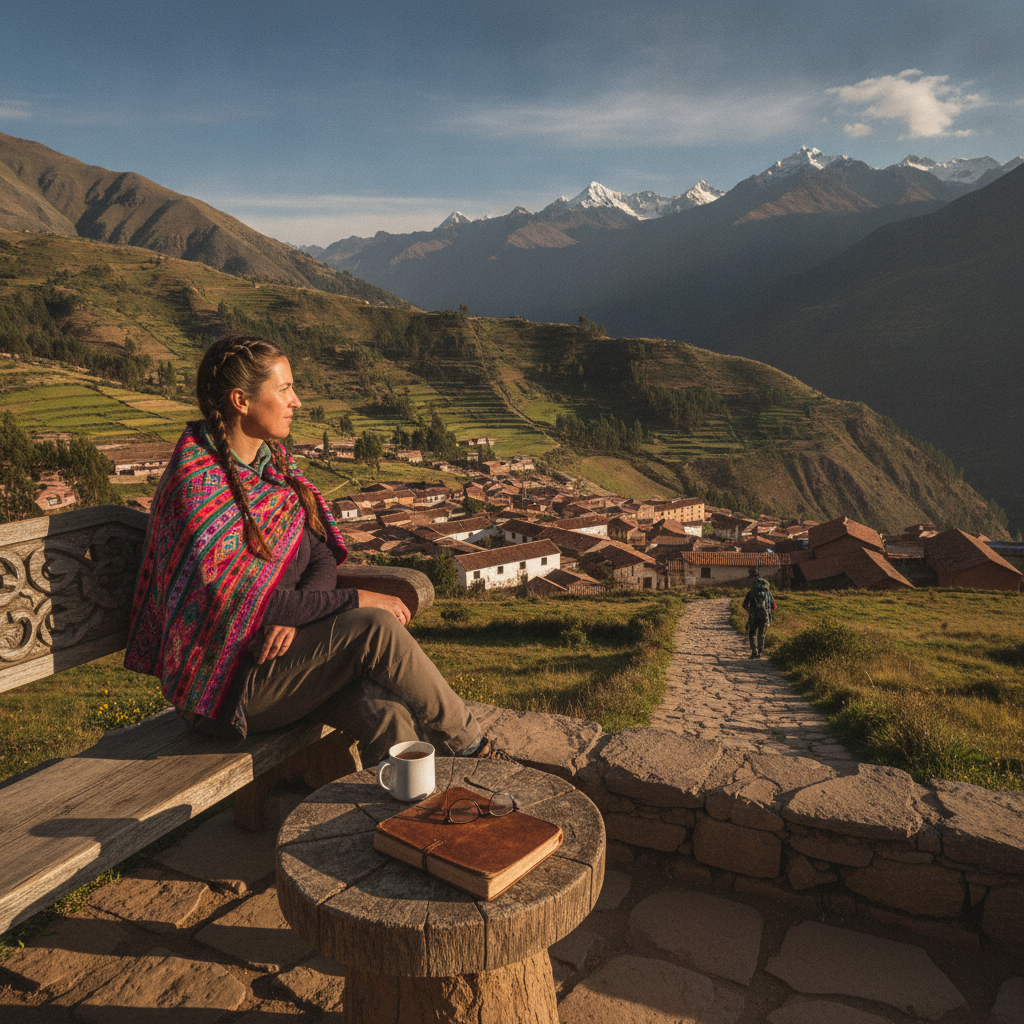
There is a particular kind of exhaustion that accumulates in the mountains — not merely in the legs or lungs, but somewhere deeper, in the part of the body that has been bracing against altitude, cold, and constant motion for days on end. Experienced trekkers in the Andes know this feeling well. It arrives not as collapse but as a quiet insistence that the pace must change, that the body needs something the trail cannot offer. What experienced Andean travelers have discovered is that the solution rarely lies in a comfortable hotel in Cusco or a bus back to Lima. It lies, instead, in the small towns that sit between the stages — places where time moves differently, where the rhythms of the market week still govern daily life, and where rest can become something genuinely restorative rather than merely passive.
The Logic of Pausing in Smaller Places
The Andean highlands are dotted with towns that most trekking itineraries pass through in an hour or less — Pisac, Ollantaytambo, Chinchero, and smaller settlements still that don't appear on standard tourist maps. Each of these places carries its own texture, its own market days, its own relationship to the surrounding landscape. When a traveler chooses to stop in one of them for three or four days rather than pressing forward, something shifts in how the environment is experienced. The eye begins to notice things that motion obscures: the way light moves across the Sacred Valley in the late afternoon, the particular sound a cobblestone plaza makes on a Sunday morning, the unhurried conversation between vendors who have known each other for decades. Slow travel sabbaticals, as this practice is increasingly called, are less about the absence of movement than about the deliberate cultivation of stillness in a place where stillness has cultural roots.
Acclimatization as Both Physical and Psychological Practice
At elevations between 3,000 and 4,000 meters, the body is engaged in constant physiological negotiation. Red blood cell production increases, breathing patterns shift, sleep becomes lighter and more interrupted. Trekkers moving rapidly between stages often underestimate how much cognitive and emotional bandwidth this adaptation requires. The concept of *soroche* — the Quechua and Spanish term for altitude sickness — is widely understood, but the subtler fatigue of sustained high-altitude exertion is less discussed. Spending several days in a mid-altitude Andean town allows the body to consolidate its acclimatization without the additional stress of forward momentum. Towns like Ollantaytambo, sitting at roughly 2,800 meters in the Sacred Valley, offer an ideal physiological bridge between the lowlands and the demanding passes of longer routes like the Salkantay or Ausangate circuits. The rest is doing work even when it doesn't feel like it.
Reading the Rhythm of Market Towns
In the Andean world, the *feria* — the weekly market — functions as far more than a commercial event. It is a social institution, a gathering that draws communities from surrounding villages and organizes the week around its presence. In Pisac, the Thursday and Sunday markets bring traders who have walked for hours from higher settlements, carrying textiles, produce, and goods that reflect the extraordinary agricultural diversity of the region. For the traveler in sabbatical mode, attending a *feria* offers something that guided tours cannot replicate: the experience of participating in an ongoing cultural rhythm rather than observing a curated version of it. Shopping for food at a local market, learning the names of unfamiliar tuber varieties from the Andean *papa nativa* tradition, or watching the careful negotiation of price between neighbors — these small interactions accumulate into a genuine sense of place that rushing between stages never allows.
What Slower Days Actually Restore
The restorative value of a slow travel sabbatical in the Andes is not simply physical. There is a particular kind of mental clarity that emerges after two or three days without a demanding objective — no pass to cross, no elevation profile to study, no weather window to chase. The mind, relieved of logistical pressure, begins to process what the trek has already offered: the views, the encounters, the moments of discomfort and exhilaration. This is not idle time; it functions more like the consolidation phase in learning, where the deeper meaning of an experience settles into memory. Towns with a quiet central plaza, a reliable *comedor* — a simple local restaurant — and a few hours of afternoon warmth create the conditions for this kind of integration. Apps like iOverlander and forums on platforms like The Hiking Life can help identify which towns have the infrastructure for a multi-day stay without the tourist density that works against genuine rest.
Choosing Duration and Setting Intentionally
Not every pause serves the same purpose. A single rest day in a busy town functions as recovery; two to four days in a quieter settlement begins to feel like something more considered. The distinction matters because the psychological shift that slow travel produces takes time to arrive. The first day is often spent sleeping and eating; the second involves a tentative exploration of the surrounding streets; by the third, the traveler begins to feel genuinely unhurried, which is the state that makes everything more visible and more meaningful. Choosing a town with limited wi-fi and few organized tourist activities is not a sacrifice but a structural support for deeper rest. The absence of obvious things to do creates the conditions in which quieter pleasures — a conversation with a *arriero* (a muleteer or mountain guide), a walk to a viewpoint that isn't on any list, an afternoon reading in the sun — become fully satisfying rather than merely adequate.
Making the Sabbatical Work Within a Longer Route
For trekkers planning multi-stage routes through the Andes, building sabbatical towns into the itinerary from the beginning produces a more coherent journey than treating rest as something squeezed between stages when exhaustion demands it. Placing a three-day pause after a demanding section like the Choquequirao approach, or before the final push toward a high camp on the Ausangate circuit, gives the body and mind time to reset with intention rather than urgency. When you plan this way, the sabbatical becomes part of the journey's architecture — not a gap in the adventure but a different register of it, one that lets the landscape and culture speak in a lower, more lasting voice. The towns you choose to linger in often become the memories that outlast the summit moments, precisely because you were present enough, and unhurried enough, to let them leave a mark.
There is something fitting in the fact that the Andean world, which has always organized itself around the interplay of movement and rest — the seasonal migration of herders, the rhythmic cycles of planting and harvest — offers the modern trekker the same wisdom. The mountains reward those who learn to pause within them, not just those who cross them quickest. The traveler who builds a slow sabbatical into a high-altitude journey doesn't arrive at the end with less experience; they arrive with more of it, sorted and settled, the kind that stays.