There is a particular kind of stillness that settles over a traveler standing alone on a rural train platform in Japan, watching a departing train disappear into a cedar-lined valley, holding a ticket they can only partially read. No phrasebook covers this moment completely. No translation app captures the texture of it. And yet, somehow, most people who find themselves in this situation do not panic — they adapt, they observe, and they discover that communication is a much broader and more forgiving thing than language alone suggests.
The Grammar of Gesture and Context
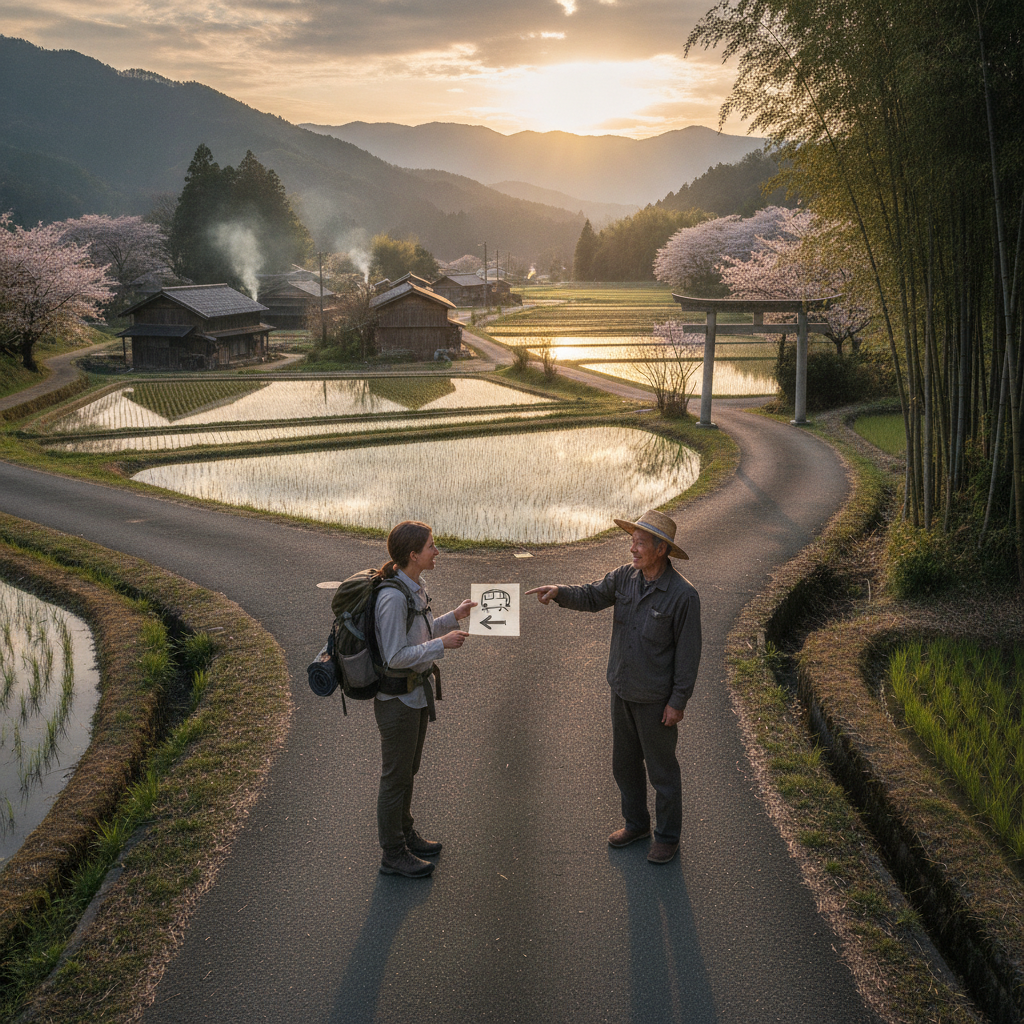
Rural Japan operates with a kind of quiet social precision that rewards attentiveness. When words fail entirely, context steps in with surprising reliability. A shopkeeper in a small town outside Yamagata who doesn't speak English will still understand a confused expression followed by a pointed finger. A station attendant will mime the number of stops on his fingers, hold up fingers again to indicate the platform, and nod with genuine encouragement when the traveler finally seems to understand. These exchanges are not awkward transactions — they carry a warmth that formal communication sometimes lacks. Japan's concept of *ma*, the meaningful pause or space between things, applies here too: the silence between two people trying to understand each other is not uncomfortable, it is active. Both parties are working, and that shared effort creates its own kind of connection. Solo travelers who lean into this discover that patience is more useful than fluency.
Reading a Place Through Its Objects and Rituals
Without language to explain everything, rural Japan teaches travelers to read their surroundings differently. A small wooden box at a temple entrance, worn smooth by decades of coins, needs no sign to explain its purpose. A noren curtain — the short fabric panel hanging in a doorway — signals that a restaurant or shop is open, even when no hours are posted and no one is visible inside. Train schedules displayed in kanji become navigable through pattern recognition: the boldface numbers for departure times are unmistakable, and the color-coded lines on station boards follow a logic that becomes readable after a day or two of close attention. Apps like Google Translate's camera function help bridge specific gaps, but the deeper skill being developed is something more analogue — a habit of reading objects, arrangements, and behaviors as a language in themselves. This is the kind of observational sharpness that tends to follow travelers home and improve how they pay attention to everything.
The Particular Kindness of Japanese Rural Communities
One of the things that makes solo travel through rural Tohoku or the Noto Peninsula so manageable — even when language is nearly absent — is the particular quality of care extended to confused strangers. There is a cultural concept in Japan called *omoiyari*, which roughly translates to empathetic consideration for others, a form of thoughtfulness that anticipates needs before they are expressed. A traveler studying a map outside a convenience store in a small Akita town might find an elderly resident appearing beside them, silently pointing at the map and then down the road, walking a few steps in the right direction as demonstration. This isn't intervention — it's *omoiyari* in action, quiet and practical. Solo travelers who arrive expecting transactional exchanges often leave with something more meaningful: a sense that being a stranger, when treated this way, is not a vulnerability but an invitation.
Practical Tools That Earn Their Place
This is not to romanticize helplessness — the right tools genuinely matter on a solo rural trip through Japan. The IC card system, particularly Suica or ICOCA, removes most of the complexity from train and bus travel by functioning as a tap-to-pay transit card that works across a vast range of regional transport. Downloading offline maps on apps like Maps.me before leaving areas with reliable mobile data saves real frustration in mountain towns where connectivity is sparse. JR Pass planning, done thoughtfully before departure, can make day trips from a rural home base far more spontaneous and affordable. A small notebook with hand-drawn maps sketched by helpful locals — a surprisingly common gift — often proves more reliable than digital directions in villages where street names are nonexistent. These tools don't replace the human experience of getting slightly lost; they simply ensure that the lostness stays interesting rather than stressful.
What Gets Learned That Has Nothing to Do With Japan
The deeper curriculum of solo rural travel in Japan is not about Japan specifically. It is about the traveler's relationship with uncertainty and the assumptions they carry about what makes communication possible. Most people believe, without quite examining the belief, that language is the primary channel through which understanding flows. Rural Japan quietly dismantles this. Understanding moves through timing, through spatial awareness, through the angle of a body in relation to a door, through the particular way a person pauses before responding — all of it meaningful, none of it verbal. Travelers who return from even a short trip through places like Shimane Prefecture or the Iya Valley often describe a changed relationship with silence in their daily lives. They become slower to fill pauses, more comfortable with the unspoken, and more precise in their own gestures because they've learned how much those gestures carry.
For anyone considering this kind of journey, the most useful preparation is not a language course — though a handful of phrases goes a long way toward showing respect. It is, instead, a willingness to be genuinely present, to trade the efficiency of easy comprehension for the richer experience of working to understand. That same stillness on the train platform, the one that could feel isolating, reveals itself over time as something else entirely: a kind of clarity, the particular alertness of a person who has learned to pay full attention to the world around them. The traveler who returns from rural Japan without having spoken much will often find they have somehow communicated more than they expected — and understood far more than language made possible.