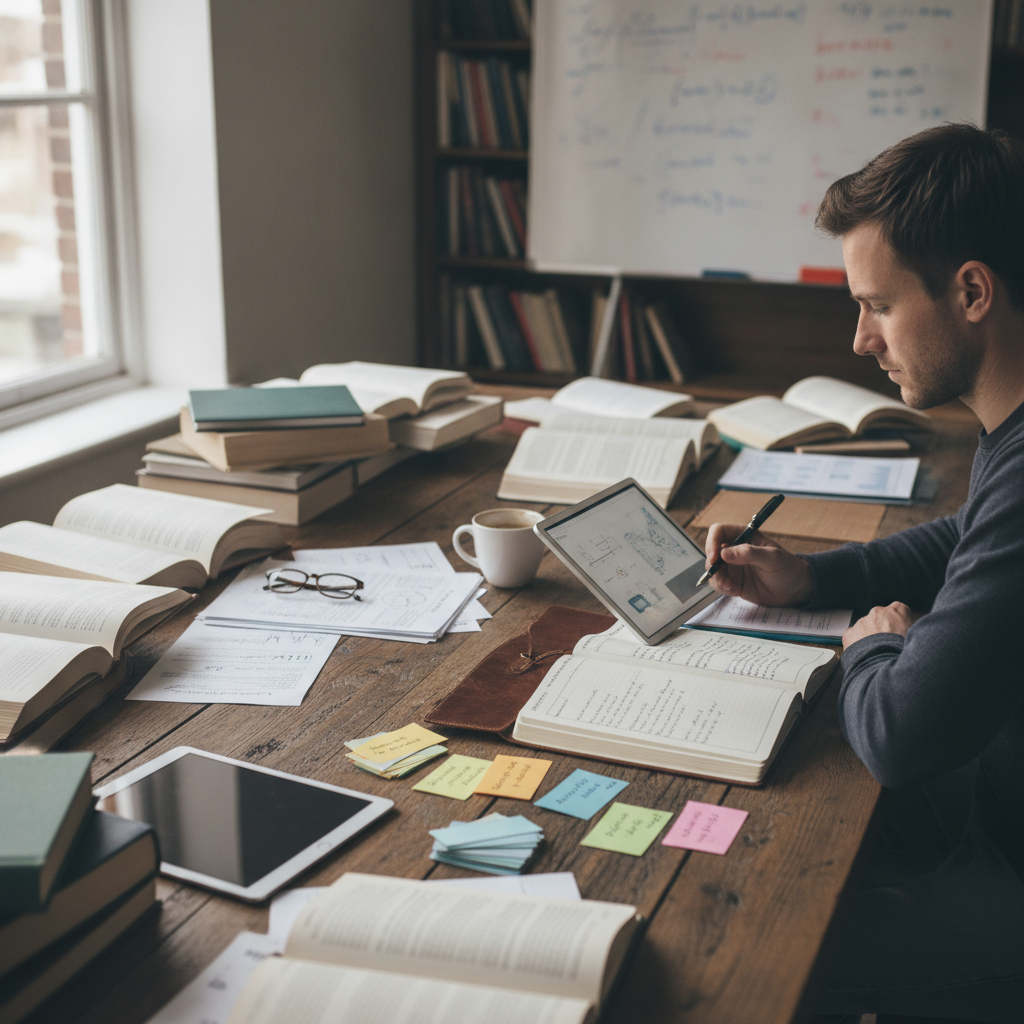
Memory is more location-aware than most people realize. When the brain encodes information, it doesn't store content in isolation — it packages that content alongside environmental cues: the ambient noise of a room, the temperature, the visual field, even the particular smell of a space. This relationship between memory and environment has real consequences for how well knowledge transfers to unfamiliar situations, and understanding it offers a practical edge for anyone serious about studying effectively.
How the Brain Ties Memory to Physical Space
Cognitive science has long recognized that memory encoding is deeply contextual. When a person studies in the same location repeatedly, the brain begins to associate what's being learned with the specific sensory details of that environment. The result is a kind of memory that works well in familiar conditions but can underperform when the context changes — like during an exam held in a room the learner has never sat in before. This phenomenon, sometimes called context-dependent memory, explains why material that felt solid during review can feel slippery in a new setting.
The Case for Environmental Variation During Study
Rotating study environments disrupts this over-reliance on location-specific cues. When information is revisited across multiple physical settings — a library branch, a quiet café like those found near university districts in cities like Edinburgh or Montreal, a park bench, a different room at home — the brain is forced to encode that material without anchoring it exclusively to one place. The memory trace becomes more generalized and, as a result, more accessible. Recall improves not because the information was studied more intensely, but because it was studied more broadly.
Why Unfamiliar Settings Create Productive Cognitive Friction
Studying in a genuinely unfamiliar environment introduces a mild form of cognitive challenge. Unfamiliar spaces require a small degree of adaptation — adjusting to new acoustics, new lighting, new social energy — and this low-level engagement keeps the mind from slipping into passive autopilot. Apps like Forest or Focusmate are popular tools for maintaining focus in variable settings, and they tend to work particularly well for learners who move between environments deliberately. The modest friction of novelty appears to enhance attention, which in turn supports more durable encoding of the material being studied.
The Role of Retrieval Practice Across Different Contexts
Environmental variation works especially well when combined with active retrieval rather than passive review. Instead of rereading notes in a new location, testing oneself on the material — through flashcards, self-quizzing, or summarizing aloud — compounds the benefit. Retrieving information in an unfamiliar setting forces the memory system to find the material without relying on contextual shortcuts. Over time, this trains the brain to access knowledge more flexibly. Medical and law students who practice recall in varied environments, including spaces that mimic exam conditions, tend to demonstrate stronger performance on assessments held in neutral rooms.
Real-World Environments That Work Well for Variable Study
Not every unfamiliar setting is equally useful. Extremely loud or chaotic spaces tend to overwhelm the working memory capacity needed for complex reasoning tasks. The most effective environments for variable study tend to be moderately novel — a branch of a public library the learner hasn't visited before, a quiet corner of a co-working space like WeWork, or even an outdoor bench in a botanical garden. The goal isn't maximum discomfort but sufficient novelty to shift the brain out of automatic contextual anchoring. A different room within the same building can even produce a measurable effect over time.
Building an Environment Rotation Into a Study Routine
For learners looking to apply this approach, the adjustment doesn't need to be dramatic. Start by identifying two or three distinct study locations within a reasonable distance — each with different sensory characteristics. Rotate between them on a weekly or session-by-session basis rather than staying loyal to one spot. When you arrive somewhere new, give yourself a few minutes to settle before beginning, then move directly into active recall rather than passive reading. Keep the material consistent across locations so the content itself remains stable while the environmental anchor shifts. Over several weeks, you'll likely notice that the material feels more retrievable in varied conditions — which is precisely the point.
The relationship between physical space and memory is neither accidental nor trivial. Learners who treat their study environment as a fixed constant may be inadvertently limiting how broadly their knowledge can be accessed when it matters most. By introducing deliberate variation — rotating through different locations, pairing that movement with active retrieval, and leaning into the mild challenge that novelty creates — it becomes possible to build a kind of memory that doesn't depend on being in the right room at the right time. That kind of robust, context-independent recall is what transforms studied knowledge into knowledge that's genuinely, reliably usable.