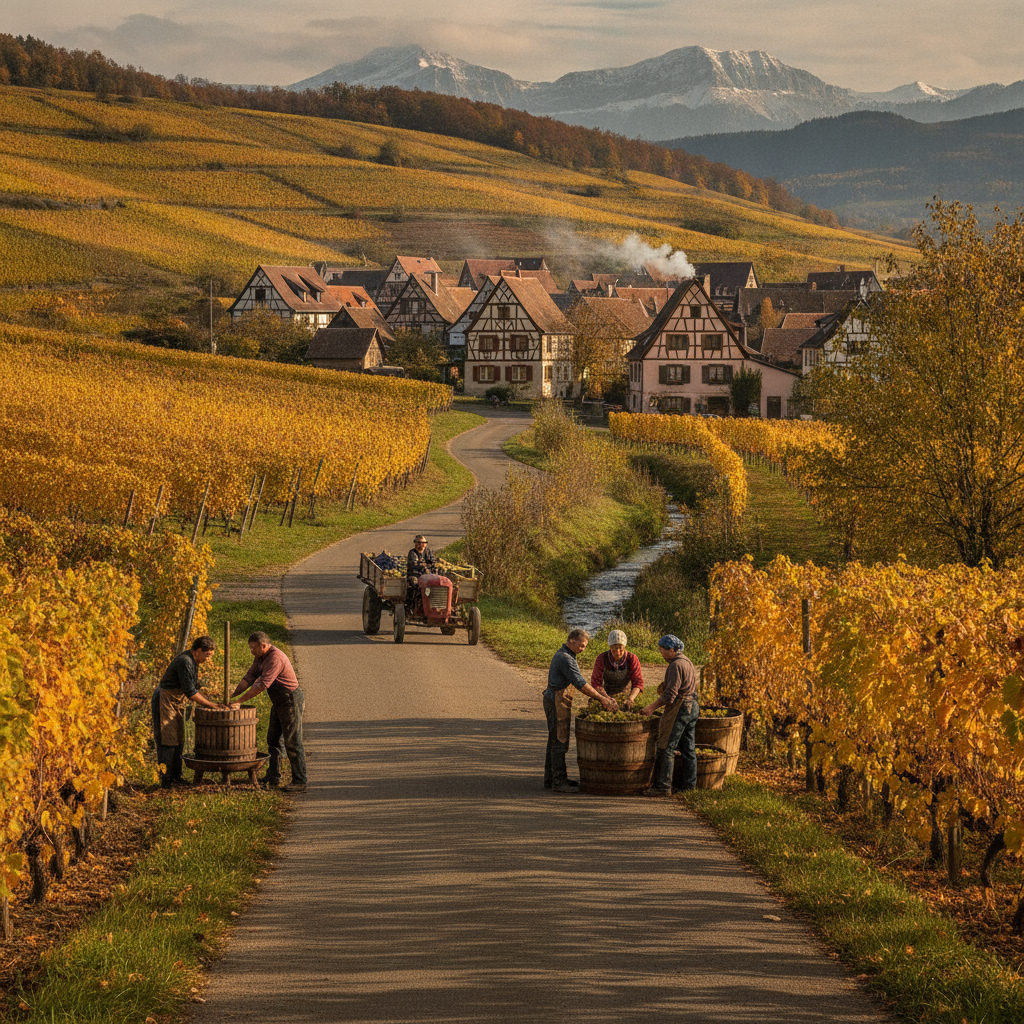
Few places on earth make the turning of a year feel as physical and collective as the wine villages of Alsace. Nestled between the Vosges mountains and the Rhine plain, this narrow corridor of northeastern France operates on a calendar that has little to do with months or meteorological charts and everything to do with the vine. To follow the harvest season here — the vendange — across two weeks in mid-autumn is to understand, gradually and sometimes unexpectedly, that wine culture is not simply an economic activity or a regional identity marker. It is the mechanism through which an entire society organizes time, community, and meaning.
The Rhythm the Vine Sets
The first thing a visitor notices when moving slowly through villages like Riquewihr, Kaysersberg, or Eguisheim during harvest weeks is that ordinary life has reorganized itself around the vine's needs rather than the clock's. Shop hours shift. Restaurants fill earlier. Tractors loaded with harvested Riesling or Gewurztraminer grapes rumble through lanes barely wide enough to accommodate them, and nobody seems inconvenienced — because everyone already knew this was coming. The vendange is not a disruption to normal life; it is normal life, arriving on schedule. The grape varieties themselves act as chapter headings in a shared seasonal story, each ripening in its own time and carrying its own character, so that the harvest unfolds not as a single event but as a procession that the whole region participates in reading.
This procession shapes daily behavior in ways that are easy to miss unless one slows down enough to watch. Winemakers in family-run domaines — many of which have operated across multiple generations in the same village — rise before light to assess overnight temperatures. Neighbors stop one another on stone-paved streets to share observations about sugar levels and morning mist. The conversation at a boulangerie counter or a market stall often has less to do with politics or weather in the generic sense and more to do with whether the Pinot Gris is ready, or whether a cold front will force an earlier-than-ideal pick. The grape variety as conversational unit is not an affectation here; it is genuinely the most relevant piece of shared information available.
When the Whole Village Becomes a Cellar
Alsace produces some of the most distinctive white wines in France, and the wine route — the Route des Vins d'Alsace — threads through more than a hundred villages across roughly 170 kilometers. But following the harvest calendar means departing from the route's tourist logic and instead tracking the work. During vendange, cellars and press houses operate continuously. The smell of fermenting must — the freshly crushed grape juice before it becomes wine — hangs over entire villages in a way that is not decorative but industrial, biological, and unmistakably seasonal. It marks time as clearly as fallen leaves or frost on the morning windowpane.
The concept of terroir, a French term used to describe the specific combination of soil, climate, slope, and microclimate that gives a wine its distinctive character, extends in Alsace far beyond the vineyard. Locals use it, consciously or not, to describe human communities as well. There is a palpable sense that the people of a particular village have been shaped by the same ground that shaped their vines — that the mineral quality of a Riesling from the Schlossberg Grand Cru reflects something genuinely shared between the wine and the people who made it. Spending time here long enough to feel that logic is one of the quieter rewards of slow travel.
Time Measured in Musts and Mists
Mid-October in Alsace arrives with a particular quality of light — lower, longer, amber-colored — that the harvest season seems specifically designed to match. The morning fogs that settle across the plain below the vineyards are not incidental scenery; they contribute to the development of noble rot, known as botrytis cinerea, which concentrates sugars in certain grape varieties and makes the late-harvest wines called Vendange Tardive and Sélection de Grains Nobles possible. These are wines made only in exceptional years, only from grapes harvested well after the main vendange, and only by growers willing to gamble on the weather holding. To understand their rarity is to understand something about how agricultural patience becomes cultural value.
Village life during this period operates with an urgency that has none of the anxiety normally associated with urgency. Decisions about when to pick are made by reading accumulated experience against present conditions — a form of practical intelligence that resists the kind of precision modern productivity culture tends to privilege. There is a looseness to the schedule that is, paradoxically, the result of paying very close attention. The best growers are not rigid; they are responsive, and the culture they inhabit rewards that responsiveness with its deepest respect.
What the Calendar Finally Teaches
By the end of two weeks spent moving slowly through harvest-season Alsace — staying long enough in places like Andlau or Saint-Hippolyte to see the same courtyard change from busy midday pressing to quiet evening cleanup — something shifts in how time itself feels. The agricultural calendar is not a romantic concept here; it is a practical inheritance that structures everything from school holidays to the timing of local festivals. The Fête des Vendanges, celebrated in towns like Obernai each autumn, is not a performance of wine culture for visitors. It is a community marking its own annual completion, the moment when a year of vineyard labor either rewards or disappoints.
This, perhaps, is what the harvest calendar ultimately reveals: that a culture built around a single, deeply seasonal product develops a relationship with time that is fundamentally different from one driven by quarterly cycles or consumer calendars. The vine doesn't respond to market trends. It responds to temperature, rainfall, and soil. When you spend enough time in a place where human life has organized itself around those same forces, the effect is genuinely reorienting — not in a dramatic way, but in the quiet, persistent way that good travel tends to work.
If you go, resist the itinerary. Let the mist decide the pace. The villages will still be there when the fog lifts, smelling of fermentation and wood smoke, doing what they have done for centuries — reading the sky and the vine, together, on their own terms. The season was never waiting to be discovered; it was already in progress.